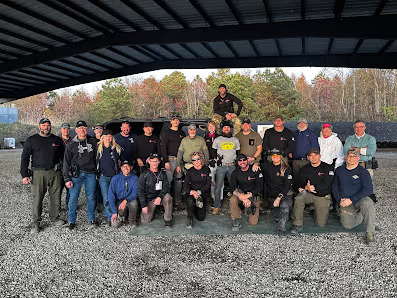
Tactical 21
103 Watson Rd
Chesapeake, VA
Firearms Training
Virginia requires a Concealed Handgun Permit to carry. It is shall-issue, the minimum age is 21, and training is required.
| Permit name | Concealed Handgun Permit |
|---|---|
| Issuing authority | Clerk of the Circuit Court of the county or city where the applicant resides (resident permits); Virginia Department of State Police, Firearms Transaction Center (nonresident permits) |
| System | shall-issue |
| Minimum age | 21 — Va. Code § 18.2-308.02(A): "Any person 21 years of age or older may apply in writing or electronically" to the clerk of the circuit court of the county or city of residence (or, for a member of the U.S. Armed Forces stationed outside the Commonwealth, the county or city in which he is domiciled). The nonresident permit under § 18.2-308.06 uses the same 21-year minimum: 'Nonresidents of the Commonwealth 21 years of age or older may apply in writing to the Virginia Department of State Police for a five-year permit.' No statutory exception lowers the age for active-duty military or any other class. Note also that § 18.2-308.014 conditions recognition of an out-of-state permit on the holder being at least 21, so an 18-20-year-old with a valid out-of-state permit is NOT recognized in Virginia. |
| Training required | Yes |
| State fee | $50 initial / $50 renewal — the state's own charge, not the total |
| Valid for | 5 years |
| Processing time | Resident: the circuit court must issue or deny within 45 days of a complete application — 'The court shall issue the permit within 45 days of receipt of the completed application.' If the court has not acted within 45 days, the applicant is entitled to a "de facto" permit — a copy of the time-stamped application serves as a permit valid for 90 days while processing continues. Nonresident: the Virginia State Police publish no stated turnaround; VSP advises that 'It is suggested that all renewal application packages be submitted at least 2 months prior to expiration.' |
| Fingerprints | Not required |
| Non-resident permit | Available |
The state fee is rarely the whole bill. Fingerprinting is usually charged by a private vendor, training is bought from an instructor, and several states add photographs, notarisation or other requirements on top.
| State fee | $50 |
|---|---|
| Training course | $75–$250 (private instructor) |
| Non-resident permit | $100 — capped separately by § 18.2-308.06 |
| Realistic total | $125–$300 |
Va. Code § 18.2-308.03 caps the whole government charge: $10 to the circuit court clerk, up to $35 to the local law enforcement agency for the background investigation and up to $5 to the State Police, with the flat instruction that 'the total amount assessed for processing an application for a permit shall not exceed $50.' Section 18.2-308.03 was not amended in the 2026 session. No fingerprints are required for the resident permit. Virginia sets no minimum hours and no live-fire requirement — § 18.2-308.02(B) lets competence be shown several ways, including a hunter-education course or prior military service, so an applicant who already qualifies pays only the $50. Fee is fully waived for retired Virginia magistrates and for retired law-enforcement officers and ABC special agents with 15 years of service or age 55+.
RESIDENT permit: Va. Code § 18.2-308.03 caps the total at $50. 'The clerk shall charge a fee of $10 for the processing of an application or issuing of a permit'; 'The local law-enforcement agency conducting the background investigation may charge a fee not to exceed $35'; 'The State Police may charge a fee not to exceed $5'; and 'The total amount assessed for processing an application for a permit shall not exceed $50.' Renewal is subject to the same $50 cap. Section 18.2-308.03 does not appear in the Code of Virginia's 2026 update list, so these amounts are unchanged. Fee waivers (read in full text on 2026-09-15): 'No fee shall be charged for the issuance of such permit to a person who has retired from service (i) as a magistrate in the Commonwealth; (ii) as a special agent with the Virginia Alcoholic Beverage Control Authority or as a law-enforcement officer ... after completing 15 years of service or after reaching age 55.' NONRESIDENT permit: a separate fee payable to the Virginia State Police — § 18.2-308.06 provides that 'The Department of State Police may charge a fee not to exceed $100 to cover the cost of the background check and issuance of the permit,' and the VSP nonresident page states the fee is '$100.00, made payable to the Virginia State Police,' by money order or cashier's check.
Apply on the official Virginia site
Virginia does not publish a central list of certified instructors. Confirm directly with Clerk of the Circuit Court of the county or city where the applicant resides (resident permits); Virginia Department of State Police, Firearms Transaction Center (nonresident permits) that a course will be accepted before you pay for it.
Businesses in our directory that offer firearms training. These are not state-verified as certified permit instructors — check against the official list above, or ask the provider directly.
103 Watson Rd
Chesapeake, VA
2601 Princess Anne St #201
Fredericksburg, VA
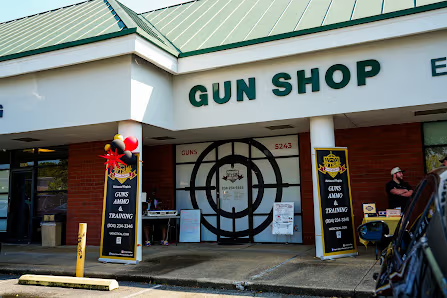
5243 S Laburnum Ave
Henrico, VA
11166 Fairfax Blvd Suite 500
Fairfax, VA

2229 Boulevard
Colonial Heights, VA
NO WALK INS PLEASE
Virginia Beach, VA
Historic District
Manassas, VA
6468 Sutcliffe Dr
Alexandria, VA
10800 Courthouse Rd Suite D
Fredericksburg, VA
6020 W Broad St
Richmond, VA
9321 Blue Pine Ln
Fredericksburg, VA
13930 Minnieville Rd
Woodbridge, VA
All firearms training in Virginia →
Virginia recognizes permits from 51 other jurisdictions.
Alaska, Alabama, Arkansas, Arizona, California, Colorado, Connecticut, District of Columbia, Delaware, Florida, Georgia, Hawaii, Iowa, Idaho, Illinois, Indiana, Kansas, Kentucky, Louisiana, Massachusetts, Maryland, Maine, Michigan, Minnesota, Missouri, Mississippi, Montana, North Carolina, North Dakota, Nebraska, New Hampshire, New Jersey, New Mexico, Nevada, New York, Ohio, Oklahoma, Oregon, Pennsylvania, Rhode Island, South Carolina, South Dakota, Tennessee, Texas, Utah, Virginia, Vermont, Washington, Wisconsin, West Virginia, Wyoming
Derived from what each of those states officially publishes.
Alaska, Alabama, Arkansas, Arizona, Colorado, Florida, Georgia, Iowa, Idaho, Indiana, Kansas, Kentucky, Louisiana, Maine, Michigan, Missouri, Mississippi, Montana, North Carolina, North Dakota, Nebraska, New Mexico, Nevada, Ohio, Oklahoma, Pennsylvania, South Dakota, Tennessee, Texas, Utah, Wisconsin, West Virginia, Wyoming
Official Virginia reciprocity page Full reciprocity matrix →
AS OF 2026-09-15: Virginia has no statute of general application prohibiting an individual from manufacturing or assembling a firearm for personal use, and no state law currently requires a serial number or state registration on a self-made firearm (Virginia maintains no firearm registry). Federal law still applies. Two limits exist today: (1) Va. Code § 18.2-308.5 makes it unlawful to 'knowingly manufacture or assemble, cause to be manufactured or assembled, import, purchase, sell, offer for sale, transfer, or possess (i) any plastic firearm or (ii) any firearm that, after removal of all parts other than a major component, is not detectable as a firearm' — a Class 5 FELONY, so undetectable/plastic builds are already illegal; and (2) manufacturing for sale requires a federal firearms license. THIS CHANGES SOON, and the effective dates were re-confirmed on 2026-09-15: Va. Code § 18.2-308.5:2, 'Prohibition on unfinished frames or receivers and unserialized firearms; penalties,' enacted by 2026, c. 532, still carries the header '(Effective January 1, 2027)'. From that date it is unlawful to knowingly import, purchase, sell, offer for sale, or transfer ownership of any completed or unfinished frame or receiver without a valid serial number (subsection B), to manufacture or assemble a firearm that 'is not imprinted with a valid serial number' (subsection D), and for an unlicensed person to sell or transfer a firearm he manufactured or caused to be manufactured (subsection E). Subsection C carries its own delayed header, '(Effective July 1, 2027) It is unlawful to knowingly possess a firearm or any completed or unfinished frame or receiver that is not imprinted with a valid serial number.' 'Unfinished frame or receiver' is defined as 'a forging, casting, printing, extrusion, machined body, or similar item that (i) is designed to or may readily be completed, assembled, or otherwise converted to function as a frame or receiver or (ii) is marketed or sold to the public to become or be used as the frame or receiver of a functional firearm once completed, assembled, or otherwise converted.' A 'valid serial number' is one imprinted by a federal licensee or assigned under state or federal law. Penalty: 'A violation of this section is punishable as a Class 1 misdemeanor. A second or subsequent violation of this section is punishable as a Class 4 felony.' Practical effect: building a firearm for personal use is lawful in Virginia today, but anyone doing so should arrange serialization by a federal licensee before January 1, 2027, and MUST have any home-built firearm serialized by July 1, 2027 to lawfully continue possessing it. Separately, § 18.2-308.5:1 makes manufacturing or possessing an auto sear or trigger activator a Class 6 felony.
Va. Code § 18.2-308.5:2 (2026, c. 532; effective January 1, 2027, subsection C effective July 1, 2027); Va. Code § 18.2-308.5