South Carolina allows permitless carry for non-prohibited adults 18+. A CWP is still available and is what other states recognize.
Permitless carry is legal in South Carolina
A non-prohibited adult aged 18 or older may
carry a concealed handgun without a permit
(since 2024).
NO PERMIT IS NEEDED TO CARRY IN SOUTH CAROLINA. Re-confirmed 2026-09-15 against the raw statute text and SLED's own guidance. SLED's Constitutional Carry Guidance page states that H.3594, signed 7 March 2024, "authorizes individuals who are not otherwise prohibited from possessing a firearm, to legally possess a firearm openly or concealed without training and without a concealed weapons permit issued by SLED," that "this law is in effect immediately," and that "it allows individuals 18 years old and older to carry firearms openly or concealed without a permit." 2024 Act No. 111 (H.3594) SECTION 3 rewrote S.C. Code Ann. Sec. 16-23-20 so that it is no longer a general carry ban; it now lists only the PLACES where carry is unlawful, and says so expressly "whether or not the person has a concealed weapon permit." Sec. 23-31-215(O)(1)(b) independently confirms that a permit "is not required for a person ... carrying a concealable weapon in a manner not prohibited by law," and (O)(2) that the availability of a permit "must not be construed to prohibit the permitless transport or carrying of a firearm in a vehicle or on or about one's person, whether openly or concealed, loaded or unloaded." Sec. 23-31-245 (added by Act 111 SECTION 19) provides that openly carrying a weapon in accordance with the article "does not give a law enforcement officer reasonable suspicion or probable cause to search, detain, or arrest the person"; SLED's guidance puts it as "Possession of a firearm alone is NOT a reason to stop an individual." Sec. 16-23-20(D): a person not otherwise prohibited may lawfully store a firearm anywhere in a vehicle, occupied or unoccupied. Off-limits places under Sec. 16-23-20(A) apply with or without a permit: law enforcement, correctional or detention facilities; a courthouse, courtroom or other publicly owned building where court is held, while court is in session; polling places on election days; the office of or a business meeting of the governing body of a county, public school district, municipality or special purpose district; school or college athletic events not related to firearms; daycare and preschool facilities; places where federal law prohibits firearms; churches or established religious sanctuaries without express permission; hospitals, medical clinics, doctors' offices and any other facility where medical services or procedures are performed, unless expressly authorized; another person's residence or dwelling without express permission; and any place clearly marked with a sign complying with Sec. 23-31-235 (a sign violation is charged only under Sec. 16-11-620, not under Sec. 16-23-20). Sec. 16-23-20(B) exempts on-duty law enforcement, certain facility employees, military on duty, qualified retired officers under Sec. 23-31-600 and persons carrying as authorized by Sec. 23-31-240. Carrying without a CWP still has consequences: Act 111 created graduated penalties for a Sec. 16-23-20 violation (misdemeanour up to one year for a first offence, up to three years for a second, a felony up to five years for a third) and an added penalty of up to three years for committing a crime involving a concealable weapon while NOT holding a valid CWP. 2026 Act No. 260 (S.136, eff. 14 Jan. 2026 on veto override) amended Sec. 17-1-65 to require the State to DISMISS pending unlawful-handgun-possession charges under the pre-2024 Sec. 16-23-20 and to allow expungement of one such conviction. The CWP remains optional and is useful mainly for out-of-state reciprocity, for easing dealer purchases, and to avoid the no-permit sentencing enhancement.
Getting the permit anyway is still worth it for most people: other states recognize
the permit, not your residency, so without one you generally cannot carry
across state lines.
S.C. Code Ann. § 16-23-20, as rewritten by 2024 Act No. 111 (H.3594), § 3, eff. March 7, 2024 (South Carolina Constitutional Carry Act of 2024)
There are 12 details on this page we
could not confirm from a primary source.
Read what they are
before relying on this.
Requirements at a glance
Permit name
Concealed Weapons Permit
Issuing authority
South Carolina Law Enforcement Division (SLED)
System
shall-issue
Minimum age
18 — 18 for both the CWP and permitless carry. Section 23-31-215(A) requires SLED to issue to "a resident or qualified nonresident who is at least eighteen years of age" — lowered from 21 by 2024 Act No. 111. Separately, § 16-23-30(A)(3) makes it unlawful to sell or deliver a handgun to a person under 18 (military/National Guard/ROTC and supervised-instruction exceptions). Federal law (18 U.S.C. § 922(b)(1)) still bars handgun purchase from a licensed dealer under 21; that is a federal limit, not a South Carolina one.
FEDERAL UNDER-21 HANDGUN PURCHASE — UPDATED 20 September 2026. The statement above describes 18 U.S.C. § 922(b)(1) and (c)(1) as written, and those provisions remain in the U.S. Code unchanged. But the Department of Justice's Office of Legal Counsel issued a 49-page opinion dated 17 September 2026, announced 18 September, concluding that they are inconsistent with the Second Amendment and "may not be enforced to impose criminal penalties on dealers who sell handguns to a class of law-abiding adults who, in nearly every other relevant respect, are members of the political community" — i.e. 18-to-20-year-olds. Read that as an EXECUTIVE-BRANCH ENFORCEMENT POSITION, not a repeal and not a judicial invalidation: the statute is untouched, an individual dealer may still decline the sale as a business matter, ATF licensing considerations and state law apply independently, and a later administration could take a different view. Separately and not bearing on age, the Fifth Circuit struck down the distinct INTERSTATE purchase ban at § 922(b)(3) in Elite Precision Customs v. ATF, No. 25-11206 (5th Cir., 18 September 2026).
Training required
Yes — no minimum set by statute or regulation; SLED's own free course is at least 4 hours hours, live fire required
State fee
$0 initial — the state's own charge, not the total
Valid for
5 years
Processing time
Up to 90 days by statute. S.C. Code Ann. Sec. 23-31-215(C): "SLED shall issue a written statement to an unqualified applicant specifying its reasons for denying the application within ninety days from the date the application was received; otherwise, SLED shall issue a concealable weapon permit." SLED's own application form adds "Processing time may be up to 90 days. A renewal application should be mailed 90-120 days prior to permit expiration." Actual average turnaround is not published by SLED. A permit granted by operation of law because no denial issued within the 90 days may still be revoked if SLED later notifies the holder that grounds for revocation or initial denial exist (Sec. 23-31-215(C)); and under budget Proviso 62.20, quoted on SLED's replacement form, a permit remains valid during the pendency of a renewal or replacement application filed before expiry.
Fingerprints
Required
Non-resident permit
Available
What it actually costs
The state fee is rarely the whole bill. Fingerprinting is usually charged by a private
vendor, training is bought from an instructor, and several states add photographs,
notarisation or other requirements on top.
State fee
$0
Fingerprinting
$5–$45 — our estimate; no vendor publishes a rate
Training course
$0–$250 (private instructor)
Realistic total
$5–$295 — includes an estimated component
PERMIT VS PERMITLESS - read these figures this way. CARRYING in South Carolina costs nothing and requires nothing: since 7 March 2024 any non-prohibited adult 18 or over may carry openly or concealed with no permit and no training. Every figure here describes the OPTIONAL Concealed Weapons Permit. The permit itself is free, and unusually flatly so: Sec. 23-31-215(C) says "SLED may not charge a fee of any kind for a concealable weapon permit," the $50 application fee having gone in August 2021. SOUTH CAROLINA'S $0 FEE IS NOT A FEE THAT HIDES A PRIVATE TRAINING BILL. Training is required for the permit, but 2024 Act No. 111 also added Sec. 23-31-215(V), which requires SLED to provide a course that satisfies the proof-of-training requirement, forbids SLED to charge participants "a fee of any kind" for it, and requires it to be offered "in every county in South Carolina at least twice per month," with extra classes where demand exceeds capacity. SLED runs that programme: a public registration page for "FREE CONCEALED WEAPONS PERMIT (CWP) CLASSES", at least four hours of instruction, a 50-question test and a 25-round qualification, and no charge. An applicant can therefore reach a permit for the $5-or-less fingerprint charge plus 25 rounds of ammunition. What is genuinely unpriced: the 25 rounds and any handgun rental from the instructor; the IdentoGo/IDEMIA electronic-capture fee, which the vendor sets and publishes nowhere (the $45 fingerprint high end is an estimate, not a published rate); and private instructors' class prices, which Sec. 23-31-215(V)(3) expressly leaves them free to set - the $250 high end. The low end of the range is the statutory $5 cap on fingerprinting by a law enforcement agency (Sec. 23-31-215(A)(6)). Renewal remains unsettled: Sec. 23-31-215(P)(1) still recites a $50 renewal fee that subsection (C) appears to have overridden, SLED publishes no fee schedule, and SLED's own current application and replacement forms request no payment at all.
Initial application: no fee. S.C. Code Ann. Sec. 23-31-215(C) states flatly: "SLED may not charge a fee of any kind for a concealable weapon permit." The prior $50 application fee was deleted from Sec. 23-31-215(A) by 2021 Act No. 66 (H.3094) SECTION 12.A, eff. 15 Aug. 2021, and SECTION 12.B inserted the no-fee sentence into (C). SLED publishes no CWP fee schedule of any kind. RENEWAL REMAINS AMBIGUOUS ON THE FACE OF THE STATUTE: Sec. 23-31-215(P)(1) still conditions renewal on "payment of a fifty-dollar renewal fee by the applicant. This fee must be waived for disabled veterans and retired law enforcement officers" - vestigial text that 2021 Act No. 66 did not conform to the broader no-fee sentence in (C). Two pieces of SLED practice point to $0, though neither states it: the current combined new/renewal application form (Form R-078, page updated 30 Mar. 2026) asks for no payment and mentions no fee anywhere, and the replacement form (Form R-02) quotes Sec. 23-31-215(L) with the five-dollar replacement fee OMITTED and lists no payment under "REQUIRED FOR PROCESSING". Renewal is therefore still reported as null rather than guessed; $0 is the likely practical answer but no primary source says so. Verify with SLED (803-896-7015 / [email protected]) before relying on it. Other statutory fees on the face of the code: a law enforcement agency may charge up to $5 for fingerprinting an applicant (Sec. 23-31-215(A)(6)); $5 for a replacement permit card and $5 on a change of permanent address (Sec. 23-31-215(L)) - both apparently not collected, see above; and SLED may recover its costs for releasing the permit-holder list to an authorised requester (Sec. 23-31-215(I)). Sec. 23-31-216 still directs SLED to "collect, retain, expend, and carry forward all fees associated with the concealable weapon application, renewal, and replacement of the permit," and SLED's FY2023-24 Fines and Fees Report still carries line items "Concealed Weapons Permit (CWP)" and "CWP Instructor Fee" against Sec. 23-31-215/216 - but that report's columns could not be aligned reliably when extracted, so no dollar amount is attributed to either line here. Third-party IdentoGo/IDEMIA fingerprint-capture charges are separate, are not set by statute, and are not published.
How to apply
FIRST: you probably do not need a permit. Since 7 March 2024 (2024 Act No. 111) any person 18 or older who is not otherwise prohibited from possessing a firearm may carry a handgun in South Carolina openly or concealed with no permit and no training (S.C. Code Ann. Sec. 16-23-20; Sec. 23-31-215(O)). The CWP is optional; people get one for out-of-state reciprocity, to ease purchases from a dealer, and to avoid the extra sentence of up to three years that Act 111 attaches to committing a crime involving a concealable weapon without a valid permit.
If you want the permit, confirm you are at least 18, are a South Carolina resident or a "qualified nonresident" who owns real property in South Carolina (Sec. 23-31-210(1)-(2)), and are not prohibited by state or federal law from possessing a handgun (Sec. 23-31-215(A)).
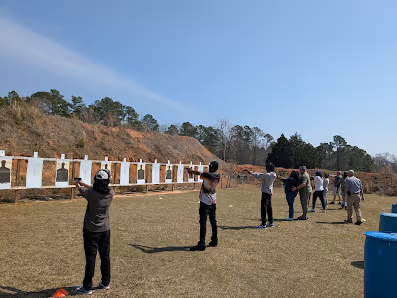
Complete the required training, which the State must give you free. Sec. 23-31-215(V) requires SLED to run a CWP course in every county at least twice a month and forbids it to charge participants any fee; register by county at https://sled.sc.gov/cwpclasses (details at https://sled.sc.gov/concealed-weapons-permit/sled-sponsored-cwp-courses). You may attend in any county, not only your own. Bring a handgun, 25 rounds of ammunition, and eye and ear protection - or arrange with the instructor beforehand to rent a handgun. The course runs at least four hours and ends in a 50-question written test and a 25-round course of fire, each of which you must pass at 70%. A paid private class from any SLED-certified instructor works equally well (find one by county or city at https://services.sled.sc.gov/CWPInstructorsWeb/Default.aspx). Training must have been completed within the three years before you apply (Sec. 23-31-210(4)).
Alternatively claim an exemption instead of taking the full course: documentation of basic military training (DD-214), retired-officer status or law enforcement academy graduation, current NRA or other SLED-approved instructor certification, active-duty police handgun instructor status, an SLED-certified competitive shooting classification, or current active/reserve military or National Guard membership (Sec. 23-31-210(4)(b)-(g)). Those applicants must still cover the South Carolina handgun and deadly-force law component.
Apply. Online: start at the SLED EasyPath services portal, https://applicants.sled.sc.gov/ (new applications, renewals and replacements), then keep the appointment it gives you at an IdentoGo/IDEMIA location (https://sc.ue.state.identogo.com/?RESTART&step=CWP), where your fingerprints are captured electronically and your documents are scanned and transmitted to SLED. On paper: use Form R-078, the combined new and renewal application at https://sled.sc.gov/sites/sled/files/CWP/CWPApplicationForm_updated03.30.2026.pdf.
Assemble the enclosures for a NEW paper application: the original signed and dated application carrying your instructor's signature, training date, instructor certificate number and student number; TWO complete legible sets of fingerprint cards (a law enforcement agency may charge up to $5 to take them, Sec. 23-31-215(A)(6)); a good-quality photocopy of your South Carolina driver's licence or state photo ID, whose address must match the application; a signed copy of the current SLED CWP Instructor/Student Checklist; proof of vision (a valid South Carolina driver's licence satisfies this, Sec. 23-31-215(A)(4)); and, for a qualified nonresident, the Real Property Tax Form (SLED Form R-168). Resident aliens add a copy of the Alien Resident card. Active-duty military add orders; retired or former military add the DD-214; retired officers add pension or retirement-benefit proof; disabled veterans add VA documentation of the disability rating.
Mail a paper application to: CWP Application, SLED Regulatory, PO Box 21398, Columbia, SC 29221 (renewals: SC Law Enforcement Division (SLED), Attention CWP Renewal, PO Box 21398, Columbia, SC 29221). No payment is requested on the form; Sec. 23-31-215(C) forbids SLED to charge any fee for the permit.
Wait. SLED runs local, state and federal fingerprint and background checks and notifies the sheriff of your county, who has ten working days to submit a recommendation (Sec. 23-31-215(B)). SLED must either issue the permit or send a written denial stating its reasons within 90 days of receipt; if it does neither, the permit is granted by operation of law (Sec. 23-31-215(C)). Questions: 803-896-7015 or [email protected]; free-course questions: [email protected].
If denied, appeal in writing to the Chief of SLED within 30 days; the Chief must decide within ten days, and an adverse decision may be taken to the Administrative Law Court within 30 days (Sec. 23-31-215(D)).
The permit is valid for five years (Sec. 23-31-215(P)), and SLED must notify you at least 30 days before expiry (Sec. 23-31-215(S)). Renew online through https://applicants.sled.sc.gov/ - SLED says an expired permit can be renewed online for up to 18 months past expiry, and by paper application after that - or by mail with the renewal application and picture identification. Renewals need no fingerprints and no new training documentation. A permit expired for no more than a year cannot be charged as a Sec. 16-23-20 violation, only fined up to $100 (Sec. 23-31-215(U)).
Report a lost or stolen permit card to SLED headquarters within 48 hours (Sec. 23-31-215(K)) and use Form R-02 for a replacement or for a change of name, address or DMV photograph; report a change of permanent address to SLED in writing within ten days (Sec. 23-31-215(L)).
Under 18 years of age (§ 23-31-215(A); § 16-23-30(A)(3))
Prohibited by state or federal law from possessing a firearm (§ 23-31-215(A))
Convicted of a crime punishable by a maximum term of imprisonment of more than one year — possession is itself a FELONY under § 16-23-500, up to 5 years for a first offense, with mandatory minimums of 5 years (second) and 10 years (third or subsequent). Excluded by § 16-23-500(F): antitrust/unfair-trade-practice type business-regulation offenses, misdemeanors punishable by 5 years or less, and expunged, set aside, pardoned or civil-rights-restored convictions
Convicted of a crime of violence in any U.S. jurisdiction (§ 16-23-30(A)(1))
Fugitive from justice (§ 16-23-30(A)(1))
Habitual drunkard or drug addict (§ 16-23-30(A)(1))
Adjudged by a circuit or county court judge to be unfit to carry or possess a firearm, after notice and hearing (§ 16-23-30(A)(4))
Member of a subversive organization (§ 16-23-30(A)(2))
CWP-specific: failure to supply proof of training, proof of residence (or proof of SC real property ownership for a qualified nonresident), proof of vision, or a complete set of fingerprints (§ 23-31-215(A))
Where to get the required training
South Carolina publishes an official list of certified instructors. That list is
authoritative — a certificate from an instructor who is not on it may not be accepted.
View the official instructor list
Training providers in South Carolina
Businesses in our directory that offer firearms training. These are
not state-verified as certified permit instructors —
check against the official list above, or ask the provider directly.
Building a firearm for one's own use is not prohibited by South Carolina law, and South Carolina imposes no state serialization or registration requirement on a self-made firearm. Two qualifications. First, § 16-23-30(C) is drafted as a removal/obliteration offense — it reaches a handgun that HAD an "original serial number" that was taken off; it does not on its face require a serial on a firearm privately made without one. No South Carolina appellate decision squarely resolving that point could be located, so treat it as an untested reading rather than settled law. Second, state silence is not the whole picture — federal law still governs: a non-licensee may make a firearm for personal use, but not an NFA-regulated firearm without ATF approval, not one violating the Undetectable Firearms Act (18 U.S.C. § 922(p)), and not with intent to sell; ATF Final Rule 2021R-05F treats certain readily-completable frame/receiver kits as firearms requiring a licensed transfer with a serial. South Carolina's own machine gun and sawed-off shotgun/rifle restrictions (§ 16-23-210 et seq.) apply independently. Local governments cannot add rules: § 23-31-510 preempts county, municipal and other political-subdivision ordinances regulating "the transfer, ownership, possession, carrying, or transportation of firearms, ammunition, components of firearms, or any combination of these things."
No South Carolina statute on point. Title 16, Chapter 23 (Offenses Involving Weapons) and Title 23, Chapter 31 (Firearms) contain no provision addressing the manufacture of a firearm for personal use, unfinished frames or receivers, 3D-printed or "untraceable" firearms, serialization of self-made firearms, or civilian firearm registration. The only serial-number provision is S.C. Code Ann. § 16-23-30(C): "A person shall not knowingly buy, sell, transport, pawn, receive, or possess any stolen handgun or one from which the original serial number has been removed or obliterated."
RECIPROCITY LIST IS INCOMPLETE, AND SLED APPEARS NOT TO PUBLISH ONE. Sec. 23-31-215(N)(1) requires SLED to "maintain and publish a list" of reciprocal states, and the SLED CWP page's prose still promises a "listing of reciprocity agreement states" - but no such link appears on that page, and SLED's own sitemap.xml (881 URLs, fetched 2026-09-15) contains no reciprocity page; /reciprocity and /concealed-weapons-permit/reciprocity both return 404, and SLED's site search returns nothing for the term. Only GA and NC are reported here, because Sec. 23-31-215(N)(2) recognises those two automatically by statute with no list required. The broader (N)(1) roster - permits from any state that requires a background check and a firearm training course, and then only when held by a RESIDENT of that state - is unverified and is certainly larger than two. The Internet Archive was rate-limiting (HTTP 429) and then timing out (HTTP 504) this session, so a former SLED list could not be recovered from a capture either. Ask SLED at 803-896-7015 / [email protected] before publishing a longer list. This matters little for the practical question: permitless carry means any non-prohibited adult 18 or over may carry in South Carolina with no permit at all.
RENEWAL FEE IS CONTRADICTED WITHIN THE STATUTE AND SLED PUBLISHES NO SCHEDULE. Sec. 23-31-215(C) says "SLED may not charge a fee of any kind for a concealable weapon permit," while Sec. 23-31-215(P)(1) still conditions renewal on "payment of a fifty-dollar renewal fee," and Sec. 23-31-216 still tells SLED to collect and retain "all fees associated with the concealable weapon application, renewal, and replacement." SLED's current combined new/renewal form (R-078) and replacement form (R-02) both request no payment, which points to $0 in practice, but no SLED page states a renewal price and the online renewal flow sits behind a login that could not be exercised. Reported as null. SLED's FY2023-24 Fines and Fees Report does still list "Concealed Weapons Permit (CWP)" and "CWP Instructor Fee" line items against Sec. 23-31-215/216; that PDF's columns could not be aligned reliably on extraction, so no amount is attributed to either line and the report neither confirms nor refutes a renewal charge.
TRAINING HOURS: there is no minimum in either the statute or the regulations. The 8-hour floor was deleted from Sec. 23-31-210(4)(a) by 2014 Act No. 123, and SLED's implementing regulations (S.C. Code of Regs. 73-300 to 73-340) prescribe content, instructor certification and 70% pass marks but no duration. The SLED instructor lesson plan PDF was parsed successfully this session (the baseline could not read it) and leaves its "TIME ALLOCATION" field blank. The only published figure is SLED's statement that students in its own free course "will receive at least four hours of instruction"; a private instructor is not bound by that, so a course could be shorter or much longer.
THE STATUTE SITE IS NOT CURRENT THROUGH TODAY. scstatehouse.gov states that the online Code is "current through the 2025 Session of the General Assembly," so the 2026 session is not reflected in the chapter pages relied on here. To close that gap, all 180 acts of the 2026 session and all 94 acts of the 2025 session were downloaded and searched by code section (allowing for non-breaking hyphens) rather than by bill title. The only act touching either chapter is 2026 Act No. 260 (S.136), which amends Sec. 17-1-65 to dismiss and expunge pre-2024 carry charges and changes none of the fields in this record; 2026 Act No. 146 (H.4189) mentions Sec. 16-23-500 only as a cross-reference inside a shellfish-equipment forfeiture provision. Nothing amended Sec. 23-31-210, Sec. 23-31-215 or Sec. 16-23-20 after 2024 Act No. 111, and the amendment-history lines on both chapter pages end there, consistent with the scan. scstatehouse.gov's own full-text bill search renders results client-side and returned an empty result frame to both GET and POST, which is why the acts had to be enumerated.
A PENDING BILL IS EASY TO MISTAKE FOR CURRENT LAW HERE. S.168 of the 2025-2026 session would amend Sec. 23-31-215(N), (P) and (S) to honour out-of-state permits more broadly and to have SLED renew permits automatically at no cost. It has sat in the Senate Judiciary Committee since 14 January 2025 and is NOT law. A web search summary during this verification reported its automatic-renewal and no-cost language as though it were the current statute; none of it appears in the statute text downloaded and read as raw bytes, and it was discarded.
AN OBSOLETE SLED REGULATION IS STILL ON THE BOOKS. S.C. Code of Regs. 73-60 (Article 5, "Unlawful Weapons") still says "the fee for the permit is non-refundable" and that "any permit issued by the Division shall require the weapon to be carried concealed," and refers to a bond. Both propositions were overtaken by 2021 Act No. 66 (open carry with a permit; no fee) and 2024 Act No. 111. The statute controls, but a reader who finds Reg. 73-60 first will be misled.
Real-world SLED processing time was not obtainable; only the 90-day statutory ceiling in Sec. 23-31-215(C) and SLED's advice to mail a renewal 90-120 days before expiry are reported.
The IdentoGo/IDEMIA electronic fingerprint-capture fee is not published: the scheduling entry point redirects to a session-based application at sc.ue.state.identogo.com that shows no price without starting an application. The $45 high end of fingerprintsEstimate is an estimate, not a published rate; the $5 low end is the statutory cap on fingerprinting by a law enforcement agency in Sec. 23-31-215(A)(6).
The cost figures do not price the 25 rounds of ammunition a student must bring to the range portion, nor a handgun rental from the instructor for a student who does not own one; SLED mentions both and sets no price for either.
Whether South Carolina law requires a serial number on a privately made firearm that never had one is an untested reading of Sec. 16-23-30(C); no South Carolina appellate decision applying it to a never-serialized self-made firearm could be located.
The interaction between permitless carry and Sec. 16-23-20(A)'s off-limits places was taken from the statute text and SLED's guidance page; post-Act-111 South Carolina case law interpreting Sec. 16-23-20 was not searched and may refine those boundaries.
The SLED fingerprint scheduler is a vendor application, not a document: sc.ibtfingerprint.com now 301s to sc.ue.state.identogo.com, which itself 307s onward to the application root. Recorded at the current vendor host as of 2026-09-15; expect it to keep moving, and treat a redirect from it as normal app behaviour rather than as a broken citation.