Ohio allows permitless carry for non-prohibited adults 21+. A CHL is still available and is what other states recognize.
Permitless carry is legal in Ohio
A non-prohibited adult aged 21 or older may
carry a concealed handgun without a permit
(since 2022).
YES — Ohio is a permitless-carry ("constitutional carry") state. ORC 2923.111(B)(1): "A person who is a qualifying adult shall not be required to obtain a concealed handgun license in order to carry in this state ... a concealed handgun that is not a restricted firearm." A "qualifying adult" under ORC 2923.111(A)(2) is a person who is (a) 21 or older; (b) not legally prohibited from possessing or receiving a firearm under 18 U.S.C. 922(g)(1)-(9), ORC 2923.13, or any other Revised Code provision; and (c) satisfies the criteria in ORC 2923.125(D)(1)(a)-(j), (m), (p), (q) and (s) — i.e., substantially the same disqualifier screen a CHL applicant must pass, minus the training and residency/employment items. A "restricted firearm" (dangerous ordnance, or a firearm the person is barred from having) may NOT be carried this way. ORC 2923.111(B)(3) and (C) place the permitless carrier under the same place restrictions, forbidden-carry zones, and penalties as a CHL holder. SB 215 also removed the old affirmative duty to promptly inform an officer; however, ORC 2923.12(B)(1) (as amended by SB 288, eff. April 4, 2023) still makes it an offense for a licensee or qualifying adult, when stopped for a law-enforcement purpose, to "knowingly fail to disclose that the person then is carrying a concealed handgun" before or at the time an officer asks — so you need not volunteer it, but you must answer truthfully when asked. Ohio still issues CHLs, and the AG expressly recommends getting one: a CHL is a NICS-exempt purchase credential and is what other states honor for reciprocity — permitless status travels nowhere. PENDING REPEAL BILL, NOT LAW: HB 348 of the 136th G.A. (Reps. Isaacsohn/Lawson-Rowe) would repeal ORC 2923.111 outright, reinstate the SB 215-era duty to notify, and rename the CHL a "basic competency license." As of 2026-09-15 it sits in the House Public Safety Committee, has passed neither chamber, and is not law; permitless carry is unaffected.
Getting the permit anyway is still worth it for most people: other states recognize
the permit, not your residency, so without one you generally cannot carry
across state lines.
Ohio Rev. Code § 2923.111 (enacted by SB 215, 134th G.A., effective June 13, 2022; codes.ohio.gov lists June 13, 2022 as the section's only version, so it is unamended as of 2026-09-15)
There are 7 details on this page we
could not confirm from a primary source.
Read what they are
before relying on this.
Requirements at a glance
Permit name
Concealed Handgun License
Issuing authority
County sheriff (sheriff of the county where the applicant resides, or any adjacent county; non-residents apply to the sheriff of the county where they are employed in Ohio, or any adjacent county). The Ohio Attorney General administers the program statewide, publishes the CCW manual, negotiates reciprocity, and maintains the instructor list.
System
shall-issue
Minimum age
21 — 21 for both routes. ORC 2923.125(D)(1)(b) requires a CHL applicant to be "at least twenty-one years of age"; ORC 2923.111(A)(2)(a) requires a permitless "qualifying adult" to be 21 or older. Ohio's statute contains no 18-20 exception for military members or any other class. (Ohio does allow open carry of a long gun at 18 and handgun possession by 18-20 year olds in limited circumstances, but that is separate from concealed carry.)
Training required
Yes — 8 hours, live fire required
State fee
$67 initial / $50 renewal — the state's own charge, not the total
Valid for
5 years
Processing time
Statutory maximum 45 days. ORC 2923.125(D)(1): "within forty-five days after a sheriff's receipt of an applicant's completed application form ... the supporting documentation, and, if not waived, the license fee," the sheriff must issue the license or deny it with written grounds. Actual times vary widely by county and are frequently much shorter. A temporary emergency license under ORC 2923.1213 is available on an expedited basis for a person in imminent danger.
Fingerprints
Required
Non-resident permit
Available
What it actually costs
The state fee is rarely the whole bill. Fingerprinting is usually charged by a private
vendor, training is bought from an instructor, and several states add photographs,
notarisation or other requirements on top.
State fee
$67
Fingerprinting
$15–$45 — our estimate; no vendor publishes a rate
Training course
$75–$250 (private instructor)
FBI check
varies — actual cost, added only for residents of under five years and non-residents, so excluded from the total; the Ohio AG publishes no current dollar figure for it
Realistic total
$157–$362 — includes an estimated component
ORC 2923.125(B)(1)(b) bars the sheriff from charging for the state BCI check, which is the sort of protection that usually makes a fee trustworthy — but the same section leaves the FBI check as an actual-cost pass-through for newer residents and non-residents and leaves WebCheck to a vendor, and the AG does not publish a figure for either. The fee is waived outright for serving and former military and for retired peace officers. The 8-hour course must include two hours of live fire and ends in both a written and a physical competency examination. Note that none of these costs apply to permitless carry under ORC 2923.111, which requires no fee, no application and no training.
ORC 2923.125(B)(1)(a): initial license $67 for an applicant who has been an Ohio resident five or more years; $67 PLUS the actual cost of the FBI background check for an applicant who has been a resident less than five years or who is a non-resident employed in Ohio. ORC 2923.125(F)(4): renewal $50, or $50 plus the actual FBI check cost on the same <5-year/non-resident condition. ORC 2923.125(E): duplicate/replacement license $15 with an affidavit of loss or destruction. ORC 2923.125(B)(1)(b): a sheriff may NOT charge the applicant for the BCI (state) background check. ORC 2923.125(B)(1)(c): the sheriff SHALL waive the license fee entirely — initial or renewal — for an active or reserve member of the U.S. armed forces, a person retired from or honorably discharged from active or reserve military service, a retired peace officer, and certain other retired officers described in ORC 109.77(B)(1) (the waiver does not apply where retirement was for mental disability). Fingerprinting/WebCheck vendor charges, if any, are separate. All figures re-read from the current ORC text on 2026-09-15; unchanged.
How to apply
Confirm you are 21 or older and not disqualified under ORC 2923.125(D)(1) (see disqualifiers).
Complete an approved firearms training course: at least 8 hours of instruction in safe handling and use, including a minimum of 2 hours of in-person range time and live-fire training, plus a written competency exam and a physical demonstration of competence (ORC 2923.125(G)). Find a certified instructor via the Ohio AG's Concealed Carry Instructor Search. Obtain the instructor's competency certification document.
Read the Ohio Peace Officer Training Commission pamphlet on firearms, dispute resolution, and use of deadly force (the training provider must give you the web address), and be prepared to certify that you read it (ORC 2923.125(B)(4)).
Download and complete the Ohio Attorney General's Concealed Carry License and Renewal Application form.
Determine your sheriff: the sheriff of the county where you reside, or the sheriff of any adjacent county. If you live out of state but are employed in Ohio, apply to the sheriff of the county where you are employed or an adjacent county (ORC 2923.125(B)).
Assemble supporting documents: a color photograph taken within the preceding 30 days, proof of identity/residency, the training competency certification, and (if not a U.S. citizen or national) your country of citizenship and alien registration number.
Submit fingerprints as required by ORC 2923.125(B)(5) and ORC 311.41 — via an electronic fingerprint reading device, or on a standard impression sheet if the sheriff does not possess and does not have ready access to a reader.
Pay the nonrefundable fee: $67 initial ($67 plus the actual FBI check cost if you have been an Ohio resident less than five years or are a non-resident employed in Ohio). The fee is waived for active/reserve military, honorably discharged or retired military, and retired peace officers.
The sheriff conducts the criminal records check and incompetency records check under ORC 311.41 and must issue or deny within 45 days of receiving the complete application, documentation, and fee (ORC 2923.125(D)(1)).
If denied, the sheriff must state the grounds in writing; you may appeal to the court of common pleas in that county under ORC 119.12, or challenge the records-check results (ORC 2923.125(D)(2)(b)).
Renew before expiration (5 years): submit the renewal application and $50 to the issuing sheriff (or, if you moved out of state, the sheriff who issued your prior license). Retaking the training course is NOT required for renewal (ORC 2923.125(F)).
Not legally living in the United States (ORC 2923.125(D)(1)(a)).
Fugitive from justice (ORC 2923.125(D)(1)(c)).
Under indictment or otherwise charged with a felony; a drug-abuse offense under ORC Chapter 2925., 3719., or 4729. involving illegal possession, use, sale, administration, distribution, or trafficking; a misdemeanor offense of violence; or a violation of ORC 2903.14 or 2923.1211 (ORC 2923.125(D)(1)(d)).
Convicted of or pleaded guilty to a felony or a qualifying drug offense; adjudicated a delinquent child for an act that would be such an offense; convicted of assault under ORC 2903.13 where the victim was a peace officer; or convicted of any other misdemeanor punishable by imprisonment exceeding one year (ORC 2923.125(D)(1)(e)).
Within the past 3 years, convicted of or pleaded guilty to a misdemeanor offense of violence (with narrow exceptions for a misdemeanor ORC 2921.33 resisting-arrest violation), or adjudicated delinquent for such an act (ORC 2923.125(D)(1)(f)).
Within the past 5 years, two or more violations of ORC 2903.13 (assault) or 2903.14 (negligent assault) (ORC 2923.125(D)(1)(g)).
Within the past 10 years, a violation of ORC 2921.33 (resisting arrest) (ORC 2923.125(D)(1)(h)).
Committed to any mental institution, under adjudication of mental incompetence, found by a court to be a person with a mental illness subject to court order, or an involuntary patient other than for observation (ORC 2923.125(D)(1)(i)).
Currently subject to a civil protection order, temporary protection order, or a protection order issued by another state's court (ORC 2923.125(D)(1)(j)).
Currently subject to a suspension of a previously issued Ohio CHL under ORC 2923.128(A)(2), or a similar suspension by another state (ORC 2923.125(D)(1)(m)).
An unlawful user of or addicted to any controlled substance as defined in 21 U.S.C. 802 (ORC 2923.125(D)(1)(o)).
Non-U.S.-citizen admitted to the United States under a nonimmigrant visa as defined in 8 U.S.C. 1101(a)(26) (ORC 2923.125(D)(1)(p)).
Discharged from the U.S. armed forces under dishonorable conditions (ORC 2923.125(D)(1)(q)).
Renounced U.S. citizenship (ORC 2923.125(D)(1)(r)).
Convicted of, pleaded guilty to, or adjudicated a delinquent child for domestic violence under ORC 2919.25 or a similar violation in another state (ORC 2923.125(D)(1)(s)).
A non-resident applicant who is not employed in Ohio — ORC 2923.125(D)(1)(n) requires that "if the applicant resides in another state, the applicant is employed in this state," so Ohio has no general non-resident CHL.
Separately, anyone under a weapons disability under ORC 2923.13 or federally prohibited under 18 U.S.C. 922(g) is barred from both the CHL and permitless carry.
Where to get the required training
Ohio publishes an official list of certified instructors. That list is
authoritative — a certificate from an instructor who is not on it may not be accepted.
View the official instructor list
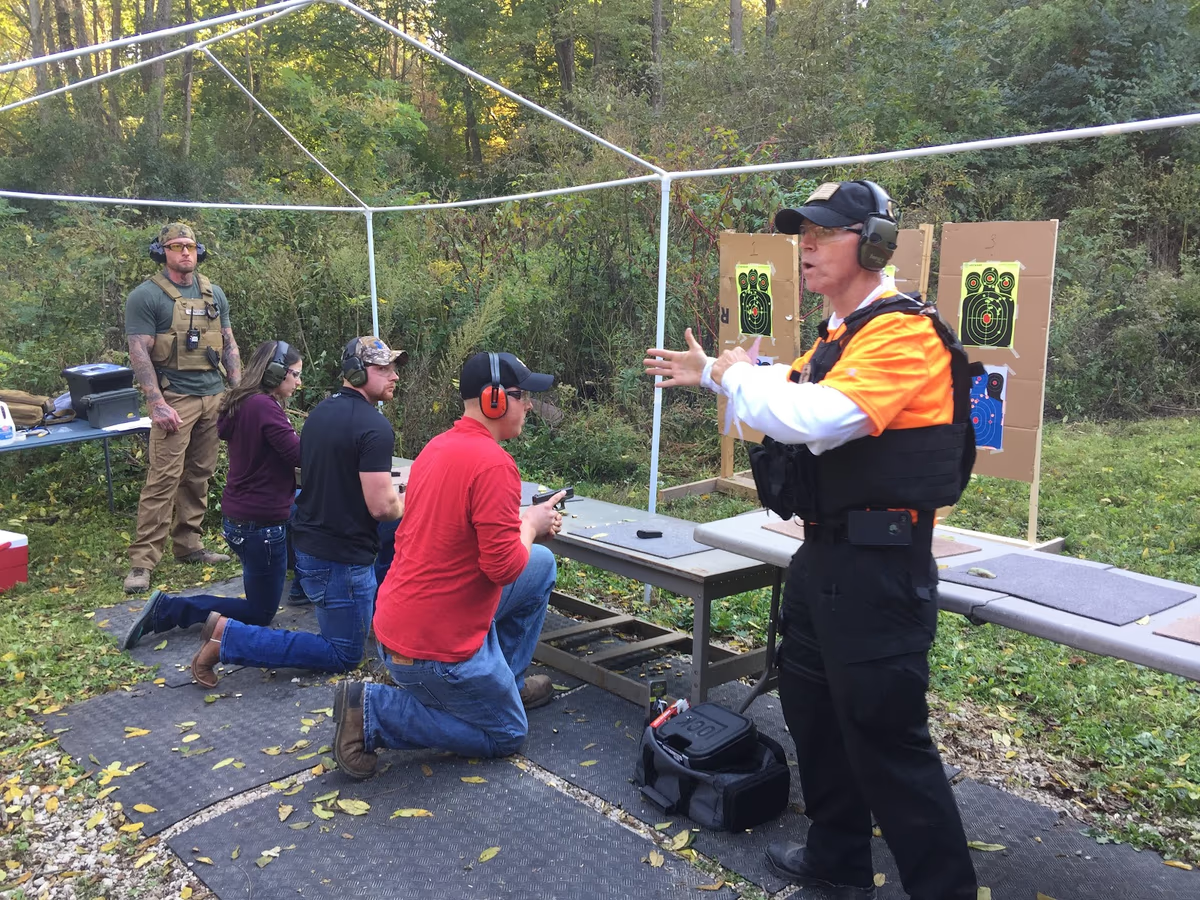
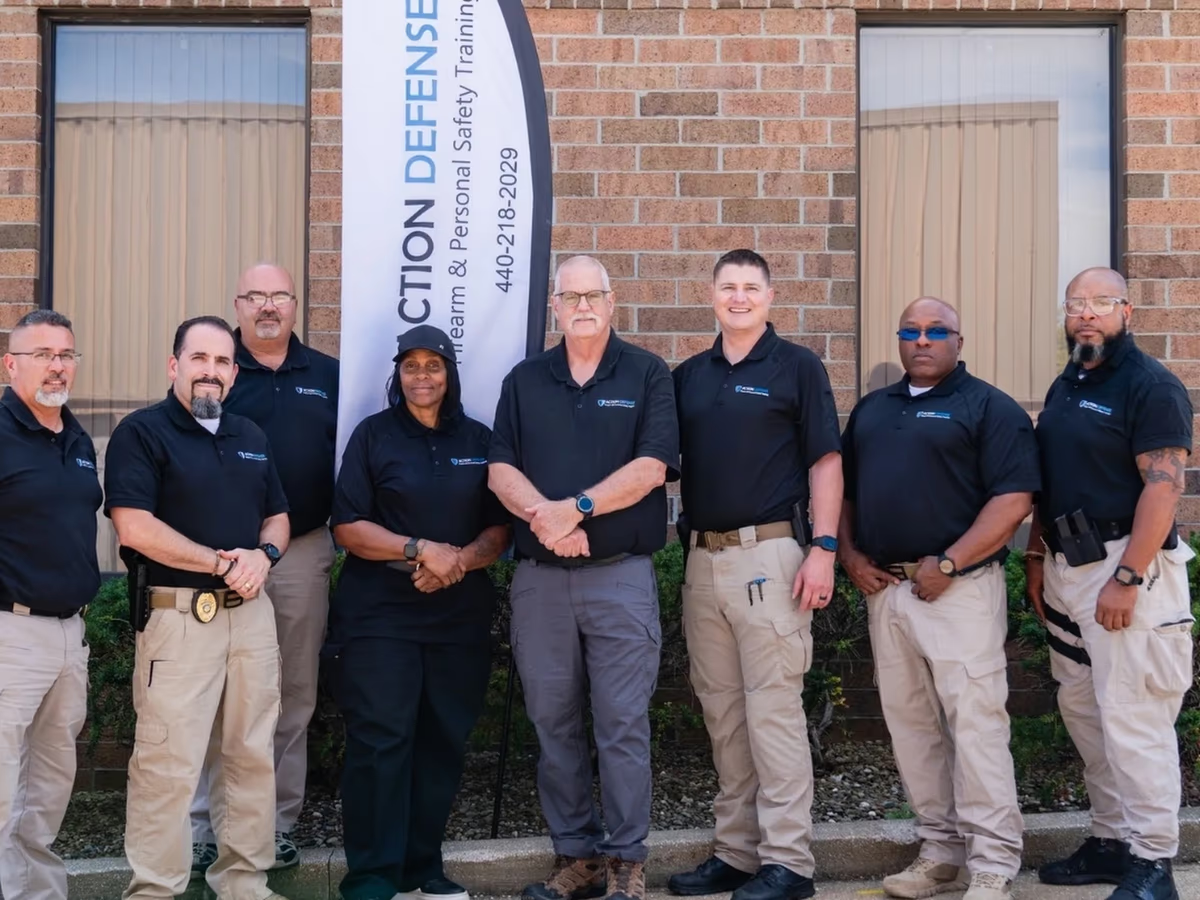
Training providers in Ohio
Businesses in our directory that offer firearms training. These are
not state-verified as certified permit instructors —
check against the official list above, or ask the provider directly.
Ohio recognizes permits from 49 other jurisdictions.
Alaska, Alabama, Arkansas, Arizona, California, Colorado, Connecticut, District of Columbia, Delaware, Florida, Georgia, Hawaii, Iowa, Idaho, Illinois, Indiana, Kansas, Kentucky, Louisiana, Massachusetts, Maryland, Maine, Michigan, Minnesota, Missouri, Mississippi, Montana, North Carolina, North Dakota, Nebraska, New Hampshire, New Jersey, New Mexico, Nevada, New York, Oklahoma, Oregon, Pennsylvania, Rhode Island, South Carolina, South Dakota, Tennessee, Texas, Utah, Virginia, Washington, Wisconsin, West Virginia, Wyoming
36 jurisdictions honor a Ohio permit
Derived from what each of those states officially publishes.
Alaska, Alabama, Arkansas, Arizona, Colorado, Delaware, Florida, Georgia, Iowa, Idaho, Indiana, Kansas, Kentucky, Louisiana, Maine, Michigan, Minnesota, Missouri, Mississippi, Montana, North Carolina, North Dakota, Nebraska, New Mexico, Nevada, Oklahoma, Pennsylvania, South Dakota, Tennessee, Texas, Utah, Virginia, Washington, Wisconsin, West Virginia, Wyoming
Ohio law affirmatively protects private manufacture and imposes no state serialization or registration requirement on a self-made firearm. ORC 9.68 was amended by SB 58 of the 135th G.A. effective April 9, 2025 (re-read in full on 2026-09-15); the amendment broadened the section — it added knives to its scope and added bans on requiring firearm liability insurance or a possession fee — and the manufacturing protection survives intact. ORC 9.68(A) now provides that, except as specifically provided by the U.S. or Ohio Constitution or state or federal law, "a person, without further license, permission, restriction, delay, or process, including by any ordinance, rule, regulation, resolution, practice, or other action or any threat of citation, prosecution, or other legal process, may own, possess, purchase, acquire, transport, store, carry, sell, transfer, MANUFACTURE, or keep any firearm, part of a firearm, its components, and its ammunition, and any knife," and the same section preempts, supersedes and declares null and void any local ordinance, rule or resolution to the contrary. There is no Ohio statute requiring a serial number on, or registration of, a privately made firearm. Ohio's serial-number statute, ORC 2923.201 (possessing a defaced firearm; still the September 28, 2006 version, its only version), only punishes changing, altering, removing, or obliterating a manufacturer's identification mark, and possessing a firearm known to be so defaced; it expressly provides that division (A) "does not apply to any firearm on which no manufacturer's serial number was inscribed at the time of its manufacture" — so a never-serialized homemade gun is not a defaced firearm. TWO REAL LIMITS. (1) ZIP-GUN / DANGEROUS ORDNANCE, A FELONY: ORC 2923.11(G)(1) defines a "zip-gun" to include "any firearm of crude and extemporized manufacture," and also any non-firearm device (e.g., a starter's pistol) specially adapted for use as a firearm, and any industrial/signalling/safety tool capable of use as a firearm when possessed, carried, or used as one. ORC 2923.11(K)(1) classifies a zip-gun as "dangerous ordnance," and ORC 2923.17(A) makes it an offense to knowingly acquire, have, carry, or use dangerous ordnance — unlawful possession of dangerous ordnance is a felony of the fifth degree. A cleanly built firearm made from a commercial receiver blank or from quality parts is generally not "of crude and extemporized manufacture," but the line is fact-specific and prosecutors have charged crude builds. A homemade suppressor is separately dangerous ordnance under ORC 2923.11(K)(5). Note also that a concealed handgun that is a "restricted firearm" (i.e., dangerous ordnance) may never be carried under ORC 2923.111. (2) FEDERAL LAW STILL APPLIES: ORC 9.68 is expressly subject to federal law. Under federal law a non-prohibited person may build a firearm for personal use without a license, but may not manufacture for sale or distribution without an FFL, may not build an NFA item without prior ATF approval, and — under ATF Final Rule 2021R-05F (effective Aug. 24, 2022) — a privately made firearm must be serialized by a licensee before any transfer, and before a gunsmith/dealer may take it into inventory.
Ohio Rev. Code § 9.68(A) (as amended by SB 58, 135th G.A., eff. April 9, 2025); see also §§ 2923.11(G) & (K)(1), 2923.17(A), 2923.201
AG CCW MANUAL EDITION DATE: the manual posted at the AG's CCWManual link is still the June 2022 edition, confirmed on 2026-09-15 from the PDF itself (its embedded source file is CCWHandbook_2022_WEB.indd and its creation timestamp is 2022-06-29). It postdates SB 215 and correctly describes permitless carry, but it predates SB 288/HB 281 (effective April 6, 2023, amending ORC 2923.125) and the April 9, 2025 amendments to ORC 2923.126 (forbidden-carry zones) and ORC 9.68. Wherever the manual and the current ORC text could differ, this record follows the current statutory text from codes.ohio.gov. Treat the manual's place-restriction chapter in particular as possibly out of date.
FEE FOR SHORT-TERM RESIDENTS AND NON-RESIDENTS: ORC 2923.125(B)(1)(a) and (F)(4) set the surcharge as "the actual cost of having a background check performed by the federal bureau of investigation" rather than a fixed dollar figure. On 2026-09-15 I checked the AG's background-check landing page, the WebCheck program page, and the BCI FBI fingerprint-card form (the last is an image-only PDF with no extractable text) and none of them publishes a current dollar amount for that FBI cost. fees.initial and fees.renewal therefore reflect only the statutory $67 and $50 bases. An applicant who has been an Ohio resident under five years, or who is a non-resident employed in Ohio, should expect to pay more than the listed figure and should ask their sheriff for the current amount.
PROCESSING TIME: 45 days is the statutory ceiling in ORC 2923.125(D)(1). Actual per-county turnaround is set by each of Ohio's 88 sheriffs and I did not verify any individual county's real-world timeline against an official source. County practice also varies on fingerprinting logistics (whether the sheriff's office has an electronic reader on site under ORC 2923.125(B)(5)) and on which WebCheck vendor, if any, an applicant is sent to — so the out-of-pocket cost and the wait can both differ materially from county to county even though the statewide legal requirements do not.
HOME MANUFACTURE / "CRUDE AND EXTEMPORIZED": ORC 2923.11(G)(1) makes "any firearm of crude and extemporized manufacture" a zip-gun and therefore dangerous ordnance, a fifth-degree felony to possess under ORC 2923.17(A). I could not locate a controlling Ohio Supreme Court definition of where "crude and extemporized" ends and a lawful home build begins. My conclusion that a well-made privately manufactured firearm (e.g., a finished 80% receiver build) falls outside that definition is a reading of the text, not a confirmed holding. Anyone building a firearm in Ohio should treat build quality as legally material and consult counsel.
NO STATE SERIALIZATION MANDATE: I verified this by reading ORC 9.68 (including its April 9, 2025 SB 58 amendment), ORC 2923.201, and the Chapter 2923 section index, and finding no serialization or registration requirement for privately made firearms. This is a negative finding — proving absence — and I cannot rule out a provision elsewhere in the Revised Code that I did not review. Note that federal ATF Rule 2021R-05F still requires serialization by a licensee before transfer.
AG PUBLISHES NO ENUMERATED INBOUND LIST: the reciprocity.honors array is derived from the statutory text of ORC 109.69(B)(3) and (D)(2) plus the AG's own prose statement that Ohio recognizes any non-resident's valid out-of-state CHL, not from an official enumerated list of honored permits. The AG publishes no inbound list, because ORC 109.69(B)(3) makes one unnecessary. The state-by-state data on the AG's reciprocity page is an embedded JavaScript object describing only the OUTBOUND direction (which states honor an Ohio CHL); I read that object directly on 2026-09-15 to confirm its direction and that it contains 51 keys including DC. Any reader comparing this record to the AG's map should expect the map to be shorter and to mean the opposite thing.
U.S. TERRITORIES NOT ENUMERATED: ORC 1.59(G) read with ORC 109.69(D)(2) indicates that a U.S. territory, commonwealth or insular possession that issues a carry license would also be a "license-issuing state" whose license Ohio recognizes, but neither the statute nor the AG says so expressly, and I did not verify the current licensing systems of Puerto Rico, Guam, the U.S. Virgin Islands, the Northern Mariana Islands or American Samoa. Territories are absent from reciprocity.honors because this dataset covers the 50 states plus DC. In practice the point is close to academic: any non-prohibited person 21 or older may carry concealed in Ohio permitlessly under ORC 2923.111 regardless of what permit they hold.