Massachusetts requires a License to Carry Firearms (LTC) to carry. It is shall-issue, the minimum age is 21, and training is required.
Requirements at a glance
Permit name
License to Carry Firearms (LTC)
Issuing authority
For residents: the local licensing authority — the chief of police (or board) of the city/town where the applicant resides. Applicants may no longer apply in a town where they merely own a business; EOPSS Guidance #4 (Nov 13, 2025) Q7 and Q18 state that applicants may apply only where they reside and that non-resident business owners are no longer eligible for an LTC. For non-residents: the Firearms Records Bureau, Department of Criminal Justice Information Services (DCJIS), 200 Arlington Street, Suite 2200, Chelsea, MA 02150, acting as designee of the Colonel of the Massachusetts State Police.
System
shall-issue
Minimum age
21 — M.G.L. c.140 §131(d), read in full today, limits LTC applications to "a lawful resident 21 years of age or older residing within the jurisdiction of the licensing authority or any law enforcement officer employed by the licensing authority or any person residing in an area of exclusive federal jurisdiction located within a city or town." There is no under-21 LTC. A Firearm Identification (FID) card under §129B is a separate, non-carry credential available to younger applicants and does not authorize carrying a handgun. The non-resident temporary LTC under §131F carries no separate age figure in its own text but is subject to §121F, and DCJIS describes it as entitling holders age 21 and over.
Training required
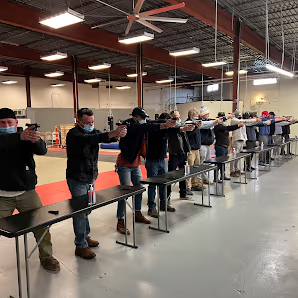
Yes, live fire required
State fee
$100 initial / $100 renewal — the state's own charge, not the total
Valid for
6 years
Processing time
Statutory maximum 40 days. M.G.L. c.140 §121F(a): the licensing authority must, within 40 days of receipt of a completed application (including renewals) under §§122, 122B, 122D, 129B, 131 or 131F, either approve and issue or deny and notify the applicant in writing of the reason — and no license may issue unless the Colonel of the State Police has certified that the available information indicates issuance would not violate state or federal law. Within 7 days of receiving the completed application the licensing authority forwards a copy plus the applicant's fingerprints to the Colonel (§121F(c)), who has 30 days to report back and certify (§121F(d)). §121F(b) entitles the applicant to a dated receipt at the time of filing. In practice local licensing authorities frequently exceed 40 days; §121F(v)(2) lets an applicant petition the District Court within 90 days after the authority's response deadline expires.
Fingerprints
Required
Non-resident permit
Available
What it actually costs
The state fee is rarely the whole bill. Fingerprinting is usually charged by a private
vendor, training is bought from an instructor, and several states add photographs,
notarisation or other requirements on top.
State fee
$100
Fingerprinting
— our estimate; no vendor publishes a rate
Training course
$75–$250 (private instructor)
Realistic total
$175–$350 — includes an estimated component
M.G.L. c.140 §121F(o)(i) itemises the $100 precisely — $25 retained by the licensing authority, $50 to the General Fund and $25 to the Firearms Fingerprint Identity Verification Trust Fund — and §121F(n) requires it to be paid to the licensing authority with no proration or refund. Nothing in §131 or §121F as rewritten by Chapter 135 of the Acts of 2024 authorizes a separate charge for taking fingerprints, the mass.gov fee schedule lists none, and the Boston and Brookline police departments both indicate the $100 covers the fingerprinting done at the application appointment — so the fingerprint estimate carried in the previous record has been set to null rather than guessed. What local authorities do add is documentary, not monetary: reference letters, a letter to the chief, proof of residency, and in Boston and Brookline a live-fire range qualification at Moon Island, which may carry its own range cost. The term is the quiet advantage: a resident license runs up to six years, behind only Florida's seven, so the annual cost is lower than the fee suggests, and §121F(p) waives the renewal fee entirely for anyone over 70. A non-resident license costs the same $100 and expires in one year with no grace period. The Basic Firearms Safety course has no statutory hour count and is not repeated at renewal, but courses completed on or after April 2, 2026 must include live fire, which tends to push course prices toward the upper end of the range.
M.G.L. c.140 §121F(o)(i) sets the fee for any firearm license, card or permit at $100, of which the licensing authority retains $25, $50 goes to the General Fund (with not less than $50,000 of General Fund deposits allocated to the Firearm Licensing Review Board established in §130B) and $25 goes to the Firearms Fingerprint Identity Verification Trust Fund (c.29 §2LLL). §121F(o)(ii) sets $25 for an LTC for active and retired law enforcement officials; §121F(o)(iii) sets $25 for an FID for persons under 18 and for a self-defense spray permit. §121F(n) requires fees to be paid to the issuing licensing authority and bars proration or refund on revocation or denial. §121F(p) EXEMPTS any person over age 70, and any law enforcement officer applying through their employing agency, from paying a renewal fee. Mass.gov fee schedule as published today: License to Carry Firearms $100; LTC for retired law enforcement officers $25; FID card $100 ($25 if under 18); Non-Resident Firearms License $100. Resident LTCs are valid for up to 6 years and expire on the anniversary of the licensee's date of birth occurring not less than 5 nor more than 6 years from issue (§131(e)); a license issued to someone born Feb 29 expires March 1. Non-resident licenses expire 1 year from date of issue with no grace period, and EOPSS Guidance #4 Q20 confirms the §121F(s) grace provisions do not apply to temporary LTCs. For resident licenses, §121F(s) keeps an expired LTC valid if renewal was applied for before expiry, during and for 180 days after active military duty, or until 90 days past the stated expiration date; §121F(t) makes possession on a license expired solely by lapse a fine of $100 to $5,000 with c.269 §10 inapplicable.
How to apply
Complete a Massachusetts-approved Basic Firearms Safety (BFS) course for an LTC, taught by a State Police-certified instructor. For courses conducted on or after April 2, 2026 this must include live-fire training and a 25-question written exam; the date you COMPLETED the course, not the date you apply, determines which standard applies. Obtain the BFS course completion certificate valid for an LTC. Find certified instructors, the approved course list (updated 09.03.2026) and the instructor public listing (08.21.2026) at https://www.mass.gov/info-details/firearms-safety-instructors-certification-program
Residents: apply to the police department of the city or town where you live (your local licensing authority) — not where you work or own a business. Non-residents: apply to the DCJIS Firearms Records Bureau, 200 Arlington Street, Suite 2200, Chelsea, MA 02150.
Apply online through the MIRCS Unified Gun Portal (https://gunportal.mass.gov/mircsUnifiedPortal/), or submit by mail or in person. If applying online, contact your licensing authority to arrange payment.
Submit the complete package: the Resident Firearms License Application (or Non-Resident License to Carry Firearms Application), the $100 fee, the BFS certificate (new applications only), photo identification, proof of residence if requested, an affidavit of lost/stolen firearms (all renewals), and any additional documentation your local licensing authority requires. You are entitled to a dated receipt under §121F(b).
Be fingerprinted. The licensing authority forwards the application and fingerprints to the Colonel of State Police within 7 days (M.G.L. c.140 §121F(c)); fingerprints may be waived on renewal if already on file with the Department of State Police.
Sit for the in-person interview with the licensing authority, which M.G.L. c.140 §131(d) requires on every initial LTC application. Non-resident applicants may be scheduled for an in-person appointment at the Firearms Records Bureau.
Satisfy any additional local requirements. These are municipal practice, not statewide law, and they vary: Boston requires applicants to qualify at the Boston Police Department Firearms Range at Moon Island within two weeks of applying, and Brookline requires two letters of reference, a letter of introduction to the Chief of Police, a Moon Island live-fire range course and proof of residency dated within two months.
Await processing: state and federal criminal background checks, a fingerprint-based check, and a Department of Mental Health check. The licensing authority must approve or deny within 40 days of a completed application (§121F(a)), and no license issues until the Colonel of State Police certifies the background result (§121F(d)).
Residents pick up the license from the local licensing authority when notified; non-resident licenses are mailed. Check status in the MIRCS portal, or call (617) 660-4722 (residents) / (617) 660-4782 (non-residents).
If denied, you may appeal to the District Court having jurisdiction within 90 days under §121F(v)(2), or in some cases petition the Firearm Licensing Review Board (§130B) — see https://www.mass.gov/how-to/appeal-a-firearms-license-denial
Any conviction or youthful-offender/delinquency adjudication, in Massachusetts or any other state or federal jurisdiction, for a felony (M.G.L. c.140 §121F(j)(i)(A))
Conviction/adjudication for a misdemeanor punishable by imprisonment for more than 2 years (§121F(j)(i)(B))
Conviction/adjudication for a 'violent crime' as defined in M.G.L. c.140 §121 (§121F(j)(i)(C))
Conviction/adjudication for a violation of any law regarding the use, possession, ownership or transfer of firearms or ammunition for which a term of imprisonment may be imposed (§121F(j)(i)(D))
Conviction/adjudication for a controlled-substance offense under c.94C or a violation of any substantially similar law of another state or federal jurisdiction (§121F(j)(i)(E))
Conviction/adjudication for a misdemeanor crime of domestic violence as defined in 18 U.S.C. 921(a)(33) (§121F(j)(i)(F)). Note that the 5-year-lookback proviso which softens clauses (B), (D) and (E) applies only to a firearm identification card under §129B, not to an LTC — for an LTC these convictions are a permanent bar
Commitment to a hospital or institution for mental illness or alcohol/substance use disorder (except a commitment under c.123 §§35 or 36C), commitment by court order to such an institution, a probate-court guardianship/conservatorship on the ground that the applicant lacks mental capacity to contract or manage their affairs, or a c.123 §35 alcohol/substance-use commitment — each subject to specified relief-of-order and 5-year physician/psychologist affidavit provisions (§121F(j)(ii))
Currently subject to a c.209A §§3B or 3C suspension/surrender order, a permanent or temporary c.209A abuse prevention order, any order described in 18 U.S.C. 922(g)(8), a permanent or temporary c.258E harassment prevention order, an extreme risk protection order under §§131R to 131Y, or an order similar to any of these issued by another jurisdiction (§121F(j)(iii))
Currently the subject of an outstanding arrest warrant in any state or federal jurisdiction (§121F(j)(iv))
Not a citizen or national of the United States and does not maintain lawful permanent residency (§121F(j)(v)). 2026 Mass. Acts c.163 expressly preserves a law enforcement agency's ability to 'request evidence of citizenship or immigration status to process an application for or renewal of any firearm license, card or permit pursuant to section 121F of chapter 140'
Discharged from the armed forces of the United States under dishonorable conditions (§121F(j)(vi))
Being determined 'unsuitable' by the licensing authority based on reliable, articulable and credible information that the applicant has exhibited or engaged in behavior that suggests the applicant may create a risk to public safety or a risk of danger to themselves or others (§121F(k)) — this discretionary ground survives Bruen and is the principal residual discretion in Massachusetts licensing; a denial on this ground must be in writing setting forth the specific reasons. For FID cards, but not for LTCs, §121F(l) strips the licensing authority of this power and requires a District Court petition instead
Under 21 years of age (M.G.L. c.140 §131(d))
Failure to submit a Basic Firearms Safety certificate meeting §131P (M.G.L. c.140 §131(b))
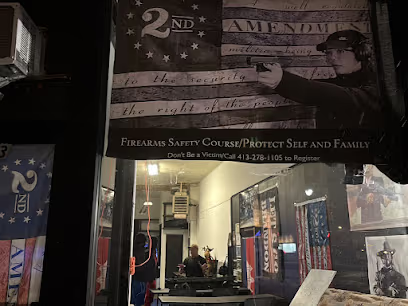
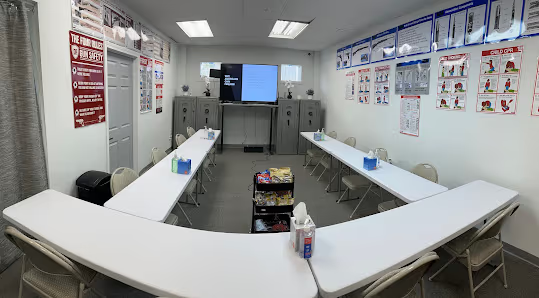
Where to get the required training
Massachusetts publishes an official list of certified instructors. That list is
authoritative — a certificate from an instructor who is not on it may not be accepted.
View the official instructor list
Training providers in Massachusetts
Businesses in our directory that offer firearms training. These are
not state-verified as certified permit instructors —
check against the official list above, or ask the provider directly.
Massachusetts recognizes no out-of-state carry permits. A permit from another state does not authorize you to carry here. Massachusetts does, however, issue its own license to non-residents — see the application details above.
25 jurisdictions honor a Massachusetts permit
Derived from what each of those states officially publishes.
Building a firearm for personal use is legal in Massachusetts ONLY if it is serialized and registered in advance/immediately, and the maker is properly licensed to possess that firearm (LTC for a handgun). M.G.L. c.140 §121C(c), read in full today: "No person shall manufacture or assemble a privately made firearm without: (i) obtaining a unique serial number from the department of criminal justice information services PRIOR to manufacture or assembly; (ii) serializing the firearm with the obtained serial number DURING manufacture or assembly; and (iii) registering the firearm with the department of criminal justice information services in accordance with section 121B within 7 days of the firearm's manufacture or assembly." §121C(b) separately bans knowingly possessing, manufacturing, assembling, purchasing, offering for sale, selling, transferring or importing an untraceable firearm; new residents and estate heirs/devisees get 60 days to serialize, licensed dealers/gunsmiths/distributors/manufacturers 7 days. §121C(a) sets marking specs: conspicuously engraved, cast or permanently embedded on the frame or receiver, not susceptible of being readily obliterated, altered or removed, at least .003 inches deep and 1/16 inch print size; non-metallic frames/receivers require a permanently embedded metal plate. §121C(d) requires privately made firearms to comply with all relevant state and federal safety regulations. §121C(g) exempts firearms delivered to law enforcement solely for destruction, in common-carrier transport, in transit in the care and custody of a non-resident owner and stored per §§131C and 131L, property of the U.S. government, produced by federally licensed manufacturers not for sale in the Commonwealth, and manufactured before October 22, 1968. PENALTIES (this was an open question in the prior record and is now resolved): M.G.L. c.269 §11C punishes whoever knowingly manufactures, assembles, imports, sells or transfers ownership of an untraceable firearm, participates in doing so, or purchases or receives a firearm knowing it is untraceable, by imprisonment for not less than 12 months and not more than 2.5 years — and possession or control of an untraceable firearm is prima facie evidence of a violation, rebuttable by evidence of no knowledge; on conviction the firearm is forwarded to the Colonel for destruction. M.G.L. c.269 §11B adds imprisonment for not less than 2.5 years for possessing or controlling an untraceable firearm while committing or attempting a felony. M.G.L. c.140 §128B requires a resident (or a non-resident receiving a firearm in the Commonwealth) who obtains a firearm other than from a §122 licensee or §128A-authorized seller to register it and report the information required by §§121B and 121C, and punishes a violation by a fine of $500 to $1,000 for a first offense and imprisonment in state prison for not more than 10 years for any subsequent offense. COMPLIANCE DATE: serial numbers are requested and firearms registered through the DCJIS MIRCS Unified Gun Portal (https://gunportal.mass.gov/mircsUnifiedPortal/), which is already live, but individuals are not required to comply with the §§121B and 121C registration and serialization requirements until OCTOBER 28, 2026 (DCJIS FAQ: "When do I have to start using the MIRCS Unified Gun Portal to register and serialize my firearms? A: October 28, 2026"; EOPSS Guidance #4 Q35, citing Chapter 135 §157). Guidance #4 also confirms a firearm that already bears a serial number need not be given a MIRCS number (Q25), and that a frame or receiver already registered must be re-registered once built into a firearm (Q27). EOPSS has promulgated both 501 CMR 19.00 (registration) and 501 CMR 20.00 (serialization), each dated 09/26/2025 on mass.gov. So: home-built firearms are NOT prohibited outright, but an unserialized/unregistered self-made ('ghost') gun is a crime, and Massachusetts's assault-style-firearm and large-capacity-feeding-device restrictions (§§131M, 131N and §131(a)) still limit what may lawfully be built.
M.G.L. c.140 §121C (serialization; untraceable firearms; privately made firearms); M.G.L. c.140 §121B (registration); M.G.L. c.140 §128B (duty to register; penalty); M.G.L. c.269 §§11A-11C (untraceable firearm offenses); 501 CMR 20.00 (Serialization of firearms); 501 CMR 19.00 (Registration of firearms)
permitSystem classification remains a judgment call. M.G.L. c.140 §131(d) says the licensing authority 'shall issue' unless the applicant is a prohibited person or is determined unsuitable — textually shall-issue. But §121F(k) preserves a discretionary 'unsuitability' denial based on 'reliable, articulable and credible information' of risk, and §131(d) mandates a personal interview on every initial application. Some observers still describe Massachusetts as effectively may-issue. I recorded 'shall-issue' on the statutory text and flag the residual discretion.
No minimum training HOURS exist in statute, in the promulgated 515 CMR 3.00, or in the published draft replacement regulation, so training.hours is intentionally empty rather than a guess. Course length is set by the individual approved course/instructor.
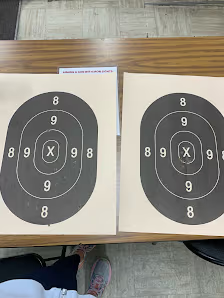
The live-fire requirement is in force, but its CONTENT is still unregulated. The promulgated 515 CMR 3.00 on mass.gov is still dated 12/16/2016 and contains no live-fire or written-examination provision; the MSP notice of Feb 24, 2026 says live-fire content regulations 'have not been finalized' and that curricula will be re-evaluated once they are promulgated; and EOPSS's published DRAFT 515 CMR 3.00 (20 rounds at 3, 7 and 10 yards on a 10.5 by 12 inch target) has not been adopted. I could not find an official mass.gov page announcing promulgation or giving a hearing date I could verify, so an applicant should expect the live-fire standard to be set by their individual approved instructor until the regulation is finalized.
The effective date of the rewritten §131P is reported inconsistently by two official sources. malegislature.gov labels the replacement text 'effective January 25, 2026' (18 months from the July 25, 2024 approval date), while EOPSS Guidance #4, the MSP notice of Feb 24, 2026 and the MSP approved-course list all use April 2, 2026 (18 months from the October 2, 2024 date EOPSS states the Act took effect). Both dates are past as of today, so the requirement is in force either way and nothing in this record turns on which is correct; I followed the agency's April 2, 2026.
Local licensing authorities impose additional requirements that are municipal practice, not statewide law, and mass.gov says only 'additional documentation as required by your local licensing authority' without itemizing. Verified examples: Boston requires range qualification at Moon Island within two weeks; Brookline requires two reference letters, a letter to the Chief of Police, a Moon Island range course and proof of residency dated within two months. I did not survey all 351 municipalities, so a given applicant's real-world requirements may be broader than this record shows.
515 CMR 3.03 as promulgated (12/16/2016, Mass Register Issue 1328) still defines LTC as 'License to Carry Firearms which shall include both Class A and Class B licenses,' while §131 as rewritten by Chapter 135 of the Acts of 2024 draws no class distinction and EOPSS Guidance #4 Q6 lists a single 'G.L. c. 140, §131: License to Carry Firearms' among the license types under the new law. The draft replacement regulation drops the Class A/B language. I treat the regulation as stale rather than as evidence that Class B LTCs are still issued, but no official page says so expressly; Chapter 135 §153 preserves the entitlements of licenses as last issued, so legacy Class A/Class B cards still in circulation keep whatever they conferred.
M.G.L. c.140 §131F's text still contains the phrase 'for purposes of firearms competition,' but reading the full sentence today that clause attaches only to the final category (a citizen or national of the United States, or a lawful permanent resident), not to the leading 'nonresident or any person not falling within the jurisdiction of a local licensing authority.' The DCJIS FAQ confirms general issuance: 'Can a non-resident obtain a license to carry a firearms in Massachusetts? Yes. The Firearms Records Bureau issues non-resident LTCs as the designee of the Colonel of the State Police.' I therefore treat the non-resident LTC as generally available, but the statutory sentence is ungrammatical as enacted and no official page construes it.
The instructor and approved-course listings are published as dated PDFs whose URLs change at each update (instructor listing now 08.21.2026, approved course list 09.03.2026), so instructorRegistryUrl points to the parent State Police program page, which links whichever PDF is current.
EOPSS Guidance #4 is internally inconsistent about the registration/serialization compliance date: Q8 says 10/2/2026 while Q35 says October 28, 2026. The DCJIS FAQ says October 28, 2026, and Q35 is the more specific answer and cites Chapter 135 §157, so I recorded October 28, 2026. Anyone relying on this within the next six weeks should confirm with DCJIS.
www.mass.gov returns HTTP 403 ('Not allowed | Mass Gov', with an X-Reference-Error header) to browser-style User-Agent strings from this datacenter IP — including for its own homepage and for paths that do not exist — so the 403s our link checker has seen are an edge WAF block, NOT moved or dead URLs. Requesting the same URLs with a plain 'curl/8.0' User-Agent returns HTTP 200, and every mass.gov URL in this record was re-fetched successfully that way today. www.sec.state.ma.us is separately unreachable from here (an Imperva cookie-challenge redirect loop), so I could not check the Massachusetts Register directly for a 515 CMR 3.00 promulgation notice.