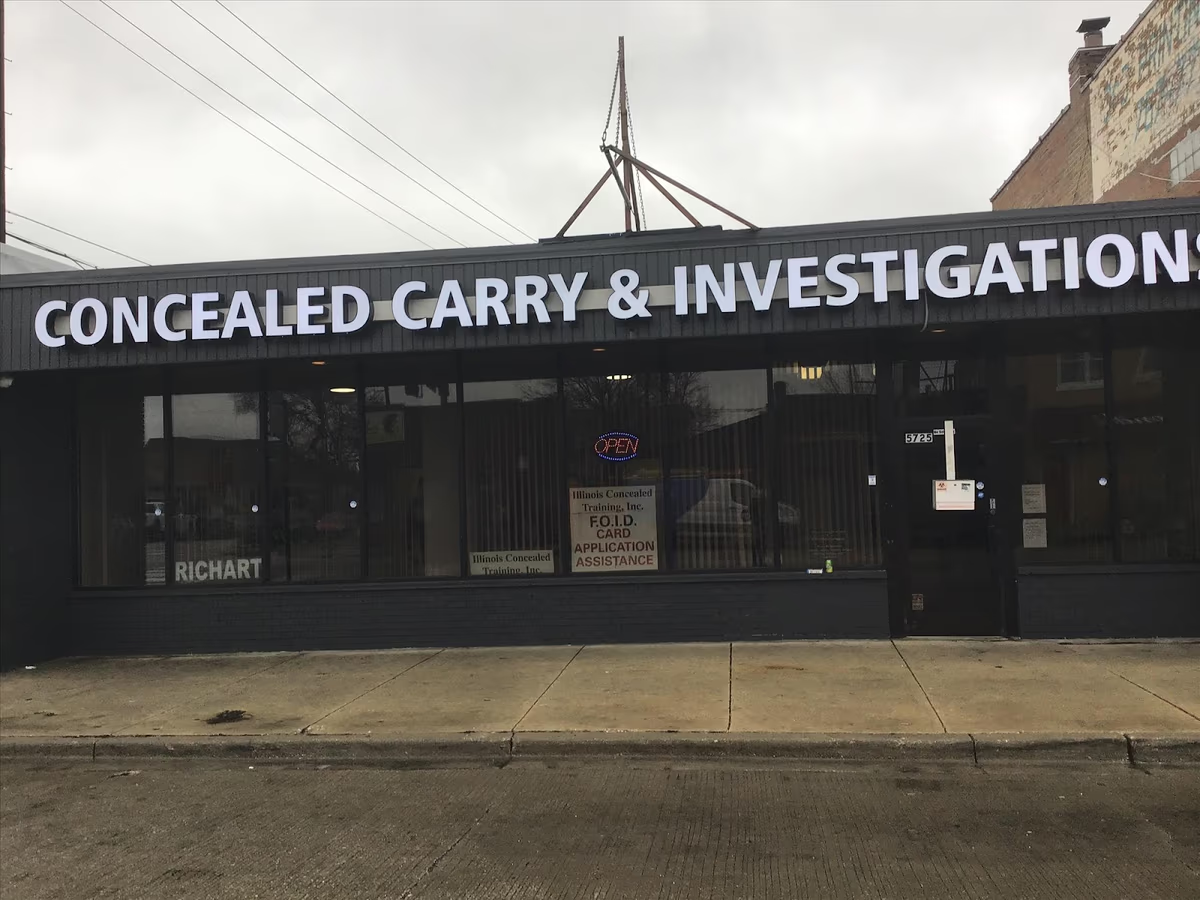
Illinois Concealed Training
5725 S Archer Ave
Chicago, IL
Firearms Training
Illinois requires a Concealed Carry License to carry. It is shall-issue, the minimum age is 21, and 16 hours of training is required.
| Permit name | Concealed Carry License |
|---|---|
| Issuing authority | Illinois State Police, Firearms Services Bureau |
| System | shall-issue |
| Minimum age | 21 — 430 ILCS 66/25(1) requires the applicant to be at least 21 years of age. There is no lower age tier for military members. A FOID card (a prerequisite) may be obtained under 21 only with a parent/guardian sponsor, but the CCL itself has a hard 21 floor. The ISP CCL eligibility checklist restates this for both residents and non-residents as 'I am at least 21 years old.' |
| Training required | Yes — 16 hours, live fire required |
| State fee | $150 initial / $150 renewal — the state's own charge, not the total |
| Valid for | 5 years |
| Processing time | CCL: 90 days with fingerprints; 120 days without (430 ILCS 66/10(e) sets the 90-day deadline, and 430 ILCS 66/30(b)(8) grants ISP '30 days in addition to the 90 days' where an application is accepted without fingerprints). The clock is tolled while the Concealed Carry Licensing Review Board considers a law enforcement objection (430 ILCS 66/15). FOID (the separate prerequisite): 30 days for a new application and 60 business days for a renewal under 430 ILCS 65/5(a)-(b). |
| Fingerprints | Required |
| Non-resident permit | Available |
The state fee is rarely the whole bill. Fingerprinting is usually charged by a private vendor, training is bought from an instructor, and several states add photographs, notarisation or other requirements on top.
| State fee | $150 |
|---|---|
| Fingerprinting | $15–$45 — our estimate; no vendor publishes a rate |
| Training course | $150–$350 (private instructor) |
| FOID card (separate mandatory prerequisite document) | $10 — 430 ILCS 65/5: $10 for a new FOID card and $10 to renew, valid 10 years (430 ILCS 65/7). This is NOT part of the $150 CCL fee - an Illinois resident carrier must hold both documents, so state fees total $160 for a first-time applicant. Active duty U.S. Armed Forces, Illinois National Guard and U.S. Reserve members are exempt from the FOID application fee. |
| Non-resident CCL surcharge | $300 — 430 ILCS 66/60(c): non-residents pay $300 rather than $150 for a new license or a renewal. Non-residents do not pay the FOID fee because they do not receive a FOID card; they instead submit the documentation ISP requires to show they would qualify for one (430 ILCS 66/40(d)). |
| Realistic total | $325–$555 — includes an estimated component |
State fees are $150 for the CCL (430 ILCS 66/60(b)) PLUS $10 for the prerequisite FOID card (430 ILCS 65/5) = $160 for a first-time Illinois resident. Do not budget for only one of the two documents: a FOID alone does not permit carry, and a CCL cannot be held without FOID eligibility. The estimated total also includes the mandatory 16-hour course and Livescan fingerprinting, which are private costs not set by statute. Illinois requires more training hours than all but a handful of states, which is why the course is the largest single component. A non-resident pays $300 instead of the $150 + $10, and must additionally obtain a notarization for the required affidavit. Renewal costs $150 (resident) or $300 (non-resident) plus 3 hours of training, with no new fingerprints.
THESE ARE CONCEALED CARRY LICENSE (CCL) FEES ONLY - the FOID card is a separate document with its own separate fee, and an Illinois carrier needs BOTH. 430 ILCS 66/60(b): 'An applicant for a new license or a renewal shall submit $150 with the application' (Illinois residents). 430 ILCS 66/60(c): $300 for a non-resident new license or renewal. 430 ILCS 66/60(d): $75 for a new/replacement license requested under Section 55. All application, renewal and replacement fees are non-refundable (66/60(a)). The ISP CCL page confirms '$150.00 payable with a credit card or electronic check' for residents and '$300.00' for non-residents; the ISP FAQ confirms the $75 replacement fee 'plus a 2.25 percent ePay service fee'. SEPARATELY, the prerequisite FOID card costs $10 for a new card and $10 for a renewal under 430 ILCS 65/5(a)-(b) (active duty U.S. Armed Forces, Illinois National Guard and U.S. Reserve members are exempt from the FOID application fee), and the FOID is valid 10 years under 430 ILCS 65/7(a) - a different term from the CCL's 5 years. So a first-time Illinois resident carrier pays $10 (FOID) + $150 (CCL) = $160 in state fees, not $150. Livescan fingerprinting and the mandatory 16-hour course are additional private costs not set by statute. 430 ILCS 66/60 has not been amended since P.A. 98-63, eff. 7-9-13.
Apply on the official Illinois site
Illinois publishes an official list of certified instructors. That list is authoritative — a certificate from an instructor who is not on it may not be accepted. View the official instructor list
Businesses in our directory that offer firearms training. These are not state-verified as certified permit instructors — check against the official list above, or ask the provider directly.
5725 S Archer Ave
Chicago, IL
6127 S University Ave STE 1101
Chicago, IL
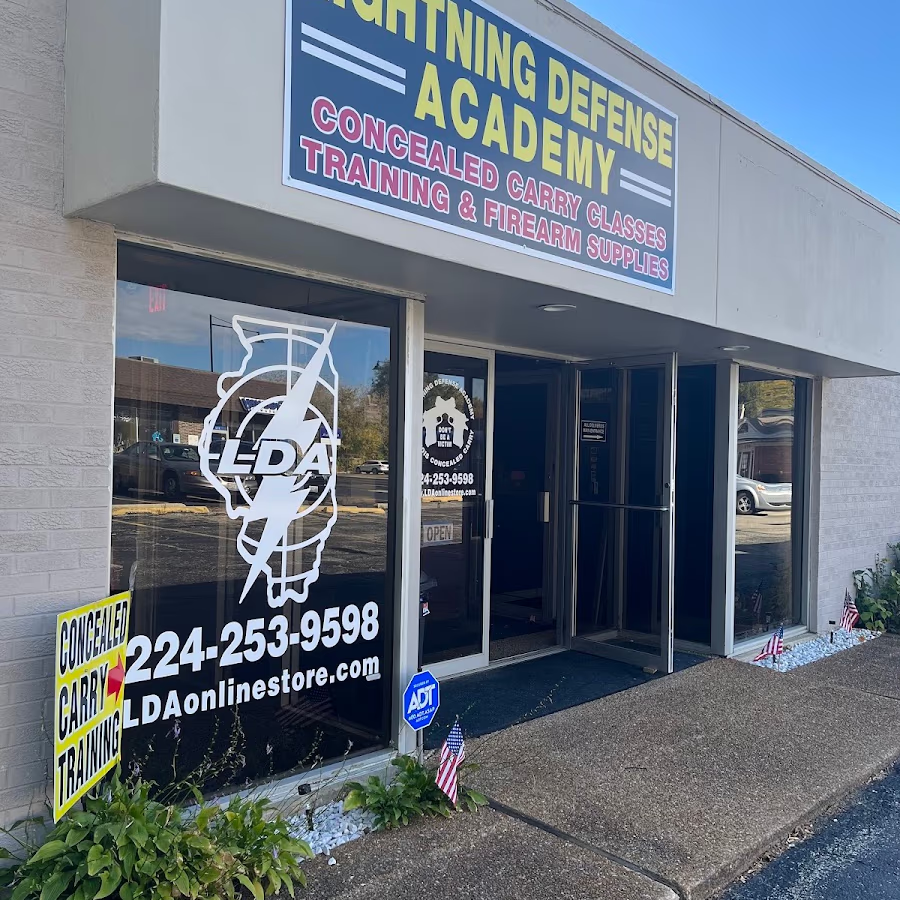
370 W Virginia St
Crystal Lake, IL
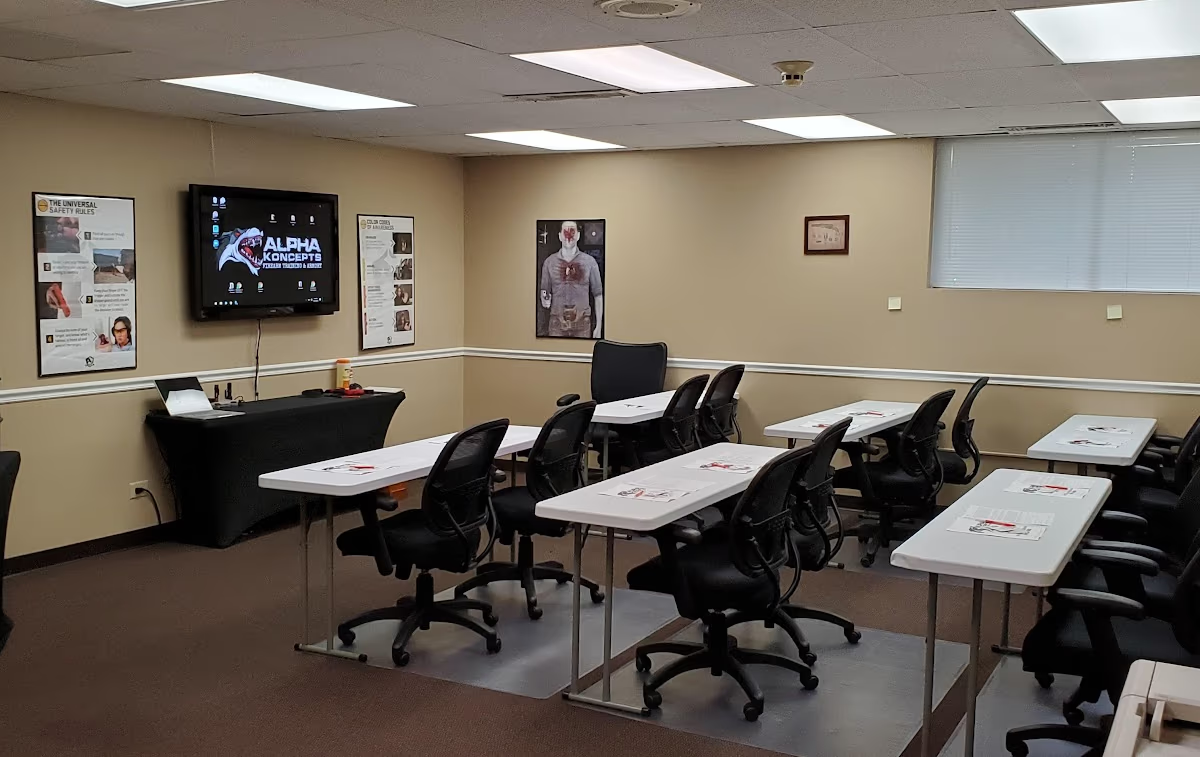
1480 Renaissance Dr #104
Park Ridge, IL
8785 N Baileyville Rd
Forreston, IL
1620 Pebblewood Ln #144
Naperville, IL
5037 W 111th St
Alsip, IL
1325 Remington Rd Suite
Schaumburg, IL
7609 N Milwaukee Ave
Niles, IL
5037 W 111th St
Alsip, IL
749 E 92nd St
Chicago, IL
1600 N Milwaukee Ave Ste 307
Lake Villa, IL
All firearms training in Illinois →
Illinois recognizes no out-of-state carry permits. A permit from another state does not authorize you to carry here. Illinois does, however, issue its own license to non-residents — see the application details above.
Derived from what each of those states officially publishes.
Alaska, Alabama, Arkansas, Arizona, Florida, Iowa, Idaho, Indiana, Kansas, Kentucky, Michigan, Minnesota, Missouri, Mississippi, Montana, North Carolina, Nebraska, Nevada, Ohio, Oklahoma, South Dakota, Tennessee, Texas, Utah, Virginia, Wisconsin
Official Illinois reciprocity page Full reciprocity matrix →
Illinois does not flatly outlaw assembling a firearm for personal use, but it has effectively closed the unserialized-build route, and getting this wrong is felony exposure. 720 ILCS 5/24-5.1 ('Serialization of unfinished frames or receivers; prohibition on unserialized firearms; exceptions; penalties') makes it unlawful for any person to knowingly possess, transport, or receive an UNFINISHED FRAME OR RECEIVER that is not serialized, and unlawful to knowingly possess, purchase, transport, or receive A FIREARM THAT IS NOT IMPRINTED WITH A SERIAL NUMBER. There is NO personal-use or hobbyist exception. Critically, an individual may NOT apply the serial number themselves: the statute provides that such items 'shall be serialized by a federally licensed firearms dealer or other federal licensee authorized to provide marking services with the licensee's abbreviated federal firearms license number as a prefix (which is the first 3 and last 5 digits) followed by a hyphen, and then followed by a number as a suffix,' marked to the federal permanence and placement standards of 27 CFR 478.124. So a lawful personal build in Illinois means starting from a frame/receiver that already bears an FFL-applied serial number, or having an FFL serialize it. Penalties: unlawful possession is a Class A misdemeanor for a first violation and a Class 3 felony for a second or subsequent violation; unlawful sale or transfer of an unserialized frame, receiver, or firearm is a Class 4 felony for a first violation and a Class 2 felony for a second or subsequent violation. Limited exceptions cover antique firearms as defined in 18 U.S.C. 921(a)(16), firearms manufactured before October 22, 1968, permanently inoperable firearms, and inherited firearms (short grace period to serialize); 3D-printed firearms carry a 30-day serialization window. There is no separate state firearm registration database for ordinary firearms, but a valid FOID card is required to possess any firearm or ammunition in Illinois, and Illinois's assault weapons and large-capacity magazine restrictions under the Protect Illinois Communities Act (P.A. 102-1116, eff. 1-10-23) independently prohibit building certain configurations. PICA IS IN FORCE TODAY: on 9 July 2026 the Seventh Circuit, in Barnett v. Raoul, Nos. 24-3060, 24-3061, 24-3062 and 24-3063 (St. Eve, J.; Brennan, C.J., dissenting), held 'We REVERSE the judgments of the district court, and we REMAND the cases with directions to enter judgments for the defendants,' undoing Judge McGlynn's judgment against the Act, and the ISP assault weapons page states that the Illinois Supreme Court reversed the Macon County judgment and 'the Protect Illinois Communities Act is enforceable across Illinois.' The Supreme Court has granted certiorari in Viramontes v. Cook County (No. 25-238), consolidated with Grant v. Higgins (No. 25-566), on whether the Second and Fourteenth Amendments protect a right to possess AR-15 platform and similar semiautomatic rifles, with argument set for 2 December 2026 - so the weapons-ban side of this may change, but none of it alters Illinois carry licensing.
720 ILCS 5/24-5.1 (added by Public Act 102-0889, eff. May 18, 2022; amended by P.A. 103-605, eff. July 1, 2024); 430 ILCS 65 (FOID Act)