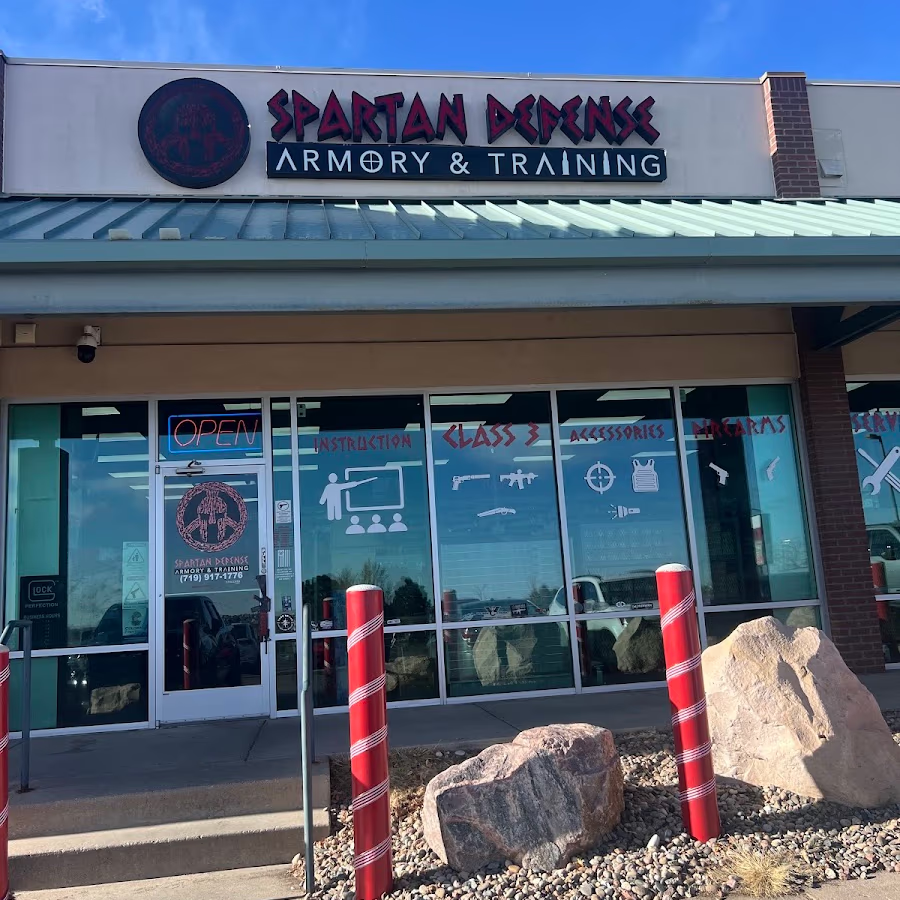
Spartan Defense Armory & Training
6130 Barnes Rd
Colorado Springs, CO
Gun Store Firearms Training
Colorado requires a Permit to Carry a Concealed Handgun (Concealed Handgun Permit) to carry. It is shall-issue, the minimum age is 21, and 8 hours of training is required.
| Permit name | Permit to Carry a Concealed Handgun (Concealed Handgun Permit) |
|---|---|
| Issuing authority | County sheriff (or city-and-county sheriff) of the applicant's county of residence; the Colorado Bureau of Investigation (CBI) runs the fingerprint and name-based background checks on the sheriff's behalf |
| System | shall-issue |
| Minimum age | 21 — C.R.S. 18-12-203(1)(b) requires the applicant to be twenty-one years of age or older for a standard 5-year CHP. Separately, C.R.S. 18-12-209 authorizes sheriffs to issue temporary emergency permits, and the statute text (read in the official Colorado Revised Statutes 2026, Title 18) expressly permits a younger applicant: under 18-12-209(2)(a) the sheriff may issue a temporary emergency permit if the sheriff determines the person may be in immediate danger and the criminal history check shows the applicant meets the 18-12-203 criteria, 'except that the applicant need not demonstrate competence with a handgun and the applicant may be eighteen years of age or older.' A temporary emergency permit is valid for 90 days; the sheriff may renew it once for a further 90 days, 'except that, if the permittee is younger than twenty-one years of age, the sheriff may renew the temporary emergency permit for subsequent ninety-day periods until the permittee reaches twenty-one years of age' (18-12-209(2)(b)(I)). So the El Paso County Sheriff's statement that persons 18-21 may be eligible for an emergency permit is statutorily correct. 18-12-209 was last amended in 2014 (HB 14-1166). |
| Training required | Yes — 8 hours, live fire required |
| State fee | $152.50 initial / $63 renewal — the state's own charge, not the total |
| Valid for | 5 years |
| Processing time | Up to 90 days. C.R.S. 18-12-206(1) requires the sheriff to approve and issue, or deny, within ninety days after receipt of the items specified in 18-12-205; under 18-12-206(2), if the CBI/FBI fingerprint results have not come back within that period the sheriff must decide without them. |
| Fingerprints | Required |
| Non-resident permit | Not available |
The state fee is rarely the whole bill. Fingerprinting is usually charged by a private vendor, training is bought from an instructor, and several states add photographs, notarisation or other requirements on top.
| State fee | $52.50 |
|---|---|
| Training course | $75–$250 (private instructor) |
| Sheriff processing fee | varies — set by each sheriff, capped at $100 for a new permit under C.R.S. 18-12-205(2)(b); El Paso County charges $82.50 |
| Realistic total | $128–$403 |
The $52.50 CBI portion is fixed statewide and itemised on CBI's fee table: $17.50 CCIC fingerprint check, $13.00 InstaCheck, $22.00 FBI fingerprint check. The sheriff's own fee is on top and varies by county up to the $100 statutory cap, so what you pay depends on where you live.
Fees are split between the sheriff and CBI and vary by county. CBI portion (fixed statewide and published on CBI's CHP page, verified 2026-09-15): $52.50 for a new application ($17.50 CCIC fingerprint check + $13.00 InstaCheck + $22.00 FBI fingerprint check); $13.00 InstaCheck for a renewal; $30.50 for a temporary emergency permit ($17.50 CCIC + $13.00 InstaCheck). Sheriff processing fee is set by each sheriff and is statutorily capped at $100 for a new permit (18-12-205(2)(b)), $50 for a renewal (18-12-211(1)(a)) and $25 for a temporary emergency permit (18-12-209(2)(a)). So the statutory ceiling is $152.50 new / $63.00 renewal - the numbers reported here. Real-world example: El Paso County charges $135.00 total for a new permit ($52.50 CBI + $82.50 county) and $63.00 to renew. Late renewal adds a $15 late fee (18-12-211(2)). CBI fees must be paid to the issuing sheriff's department by cashier's check or money order payable to CBI where the sheriff does not collect online. Fees are non-refundable if the application is denied, revoked or suspended.
Apply on the official Colorado site
Colorado does not publish a central list of certified instructors. Confirm directly with County sheriff (or city-and-county sheriff) of the applicant's county of residence; the Colorado Bureau of Investigation (CBI) runs the fingerprint and name-based background checks on the sheriff's behalf that a course will be accepted before you pay for it.
Businesses in our directory that offer firearms training. These are not state-verified as certified permit instructors — check against the official list above, or ask the provider directly.
6130 Barnes Rd
Colorado Springs, CO
12105 W Cedar Dr
Lakewood, CO
6767 S Spruce St #230
Centennial, CO
4990 Ronald Reagan Blvd
Johnstown, CO
1006 36th St
Evans, CO
Mesa County, CO
1250 N Curtis Rd
Colorado Springs, CO
1412 Woolsey Heights
Colorado Springs, CO
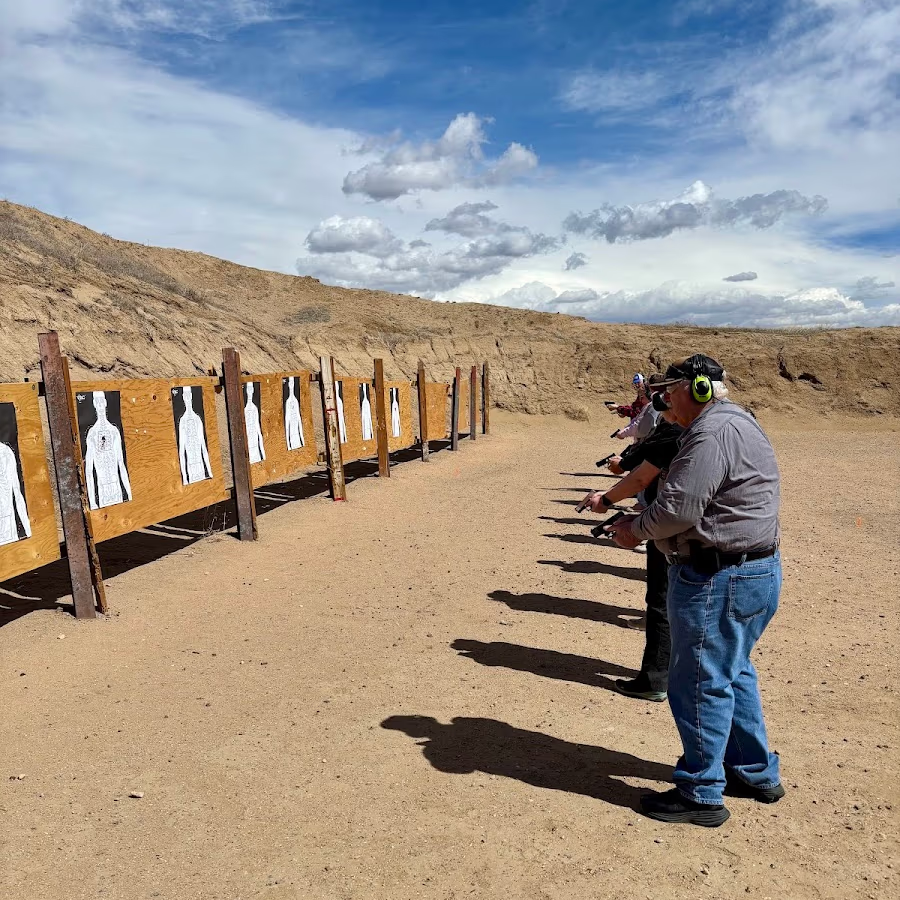
8280 White Owl Ct
Windsor, CO
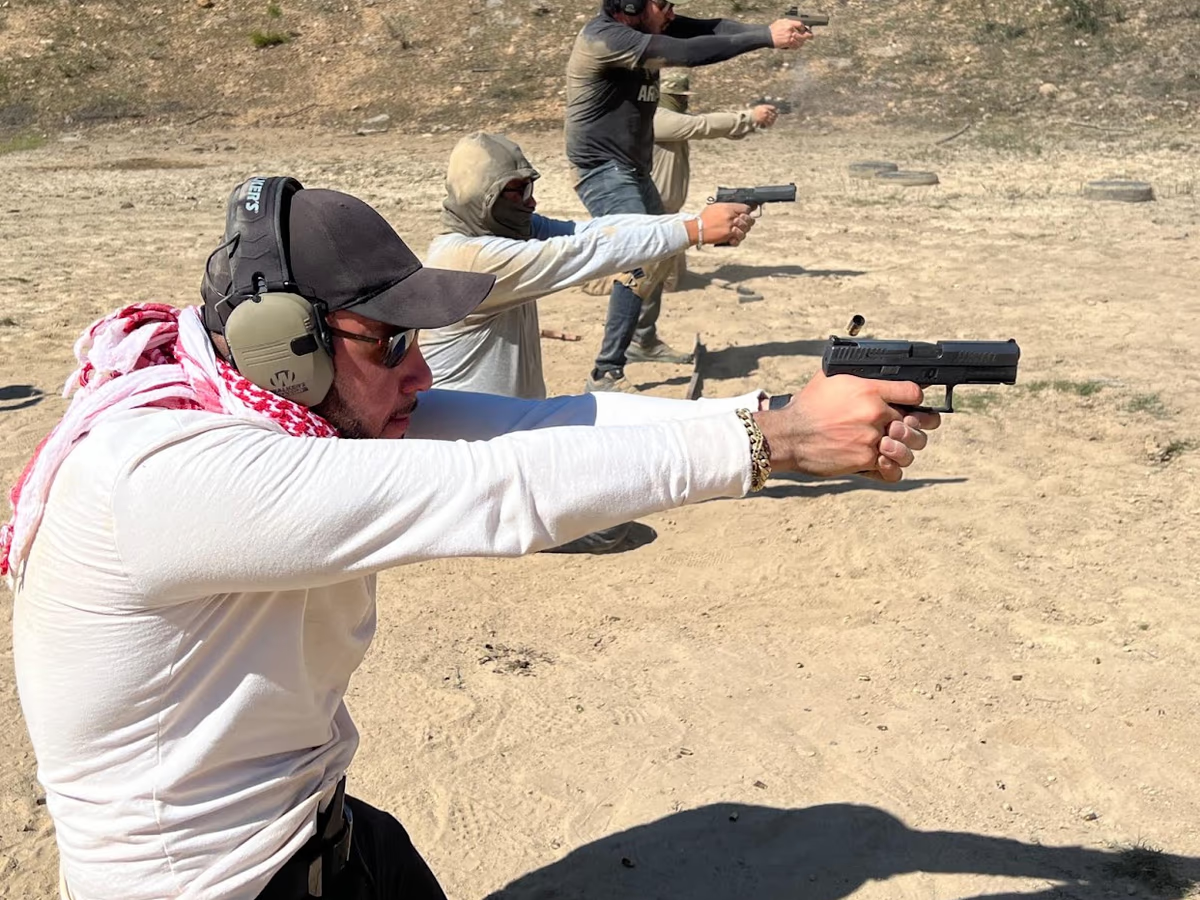
8120 Sheridan Blvd C200
Arvada, CO
2821-2851 South Parker Road
Aurora, CO

700 W 6th St
Pueblo, CO
All firearms training in Colorado →
Colorado recognizes permits from 34 other jurisdictions.
Alaska, Alabama, Arkansas, Arizona, Delaware, Florida, Georgia, Iowa, Idaho, Indiana, Kansas, Kentucky, Louisiana, Michigan, Minnesota, Missouri, Mississippi, Montana, North Carolina, North Dakota, Nebraska, New Hampshire, New Mexico, Ohio, Oklahoma, Pennsylvania, South Dakota, Tennessee, Texas, Utah, Virginia, Wisconsin, West Virginia, Wyoming
Derived from what each of those states officially publishes.
Alaska, Alabama, Arkansas, Arizona, Delaware, Florida, Georgia, Iowa, Idaho, Indiana, Kansas, Kentucky, Louisiana, Michigan, Minnesota, Missouri, Mississippi, Montana, North Carolina, North Dakota, Nebraska, New Mexico, Ohio, Oklahoma, Pennsylvania, South Dakota, Tennessee, Texas, Utah, Virginia, Wisconsin, West Virginia, Wyoming
Official Colorado reciprocity page Full reciprocity matrix →
Colorado PROHIBITS making the regulated core of a firearm for personal use. The operative ban is C.R.S. 18-12-111.5(5)(a)(I), verified verbatim in both the enrolled act (SB23-279, Ch. 311, L. 2023) and the official Colorado Revised Statutes 2026: 'A person shall not manufacture or cause to be manufactured, including through the use of a three-dimensional printer, a frame or receiver of a firearm.' The only exception in 18-12-111.5(5)(a)(II) is a FEDERALLY LICENSED FIREARM MANUFACTURER - there is no personal-use, hobbyist, or 80%-kit exemption. Note the precise scope: subsection (5)(a) bans manufacturing a FRAME OR RECEIVER, so assembling a complete firearm from components whose frame or receiver was made and serialized by an FFL is not itself a (5)(a) offense; but because the frame or receiver is the part you may not make, self-manufacture as normally understood is unlawful. Supporting prohibitions: 18-12-111.5(1) bars knowingly possessing or transporting an unfinished frame or receiver unless serialized by a federal firearms licensee; 18-12-111.5(2) bars selling/offering/transferring/purchasing an unfinished frame or receiver; 18-12-111.5(3) bars possessing, purchasing, transporting or receiving any firearm or frame/receiver not imprinted with a serial number by an FFL; and 18-12-111.5(4) bars selling or transferring such an item (exceptions for FFL importers/manufacturers, permanently inoperable firearms, defaced firearms under 18-12-103, antique firearms per 18 U.S.C. 921(a)(16), and firearms manufactured before October 22, 1968). EFFECTIVE DATES: SB23-279 took effect on passage, June 2, 2023, except that 18-12-111.5(1) and (3) took effect January 1, 2024. Anyone who already owned a self-made unserialized firearm/frame/receiver on June 1, 2023 had until January 1, 2024 to have an FFL imprint a serial number (18-12-111.5(5)(b)). An FFL serializing under 18-12-111.5(7) must imprint a number beginning with the licensee's abbreviated FFL number, and returning the item is a transfer requiring a background check under 18-12-112.5. PENALTY: class 1 misdemeanor; a SECOND OR SUBSEQUENT OFFENSE IS A CLASS 5 FELONY (18-12-111.5(6)(b)). A 18-12-111.5 conviction is also a ground for denial of a firearm transfer under 24-33.5-424(3)(b.3)(XII) and, as a felony, a bar under 18-12-108(7)(iii). LAYERED ON TOP: HB26-1144 (approved May 4, 2026, Ch. 94, L. 2026) added a separate offense effective July 1, 2026, applicable to offenses committed on or after that date. IMPORTANT CITATION CORRECTION: the enrolled act says 'add 18-12-119', but the official Colorado Revised Statutes 2026 codifies it as C.R.S. 18-12-118 and carries an editor's note stating 'This section was numbered as 18-12-119 in HB 26-1144 but was renumbered on revision for ease of location.' Cite 18-12-118. It makes it a class 1 misdemeanor (class 5 felony on a second or subsequent offense) to knowingly manufacture or produce a firearm or firearm component by means of three-dimensional printing using a 3-D printer, CNC milling machine, or similar device; 'firearm component' means an unfinished frame or receiver, large-capacity magazine, or rapid-fire device; the section applies only to potentially functional firearms and components and not to non-functioning or prop firearm parts; and the only exceptions are a federally licensed firearm manufacturer and an instructor, student, or institution of an accredited gunsmithing program where the manufacture is solely for educational instruction within that program. SERIALIZATION: the serial number must be imprinted by a federal firearms licensee; Colorado does not operate a state firearm registry - C.R.S. 29-11.7-102 prohibits a local firearms database.
C.R.S. 18-12-111.5 (added by SB23-279); C.R.S. 18-12-118 (added by HB26-1144, effective July 1, 2026 - numbered 18-12-119 in the bill but renumbered to 18-12-118 on revision)